Redundancy Factor (ρ) Explained: Why Structural Redundancy Matters in Seismic Design
Published on 2024-12-30
In seismic design, one of the most important but often overlooked concepts is redundancy.
👉 What happens if one structural element fails?
👉 Does the building still stand?
This is where the Redundancy Factor (ρ) comes into play.
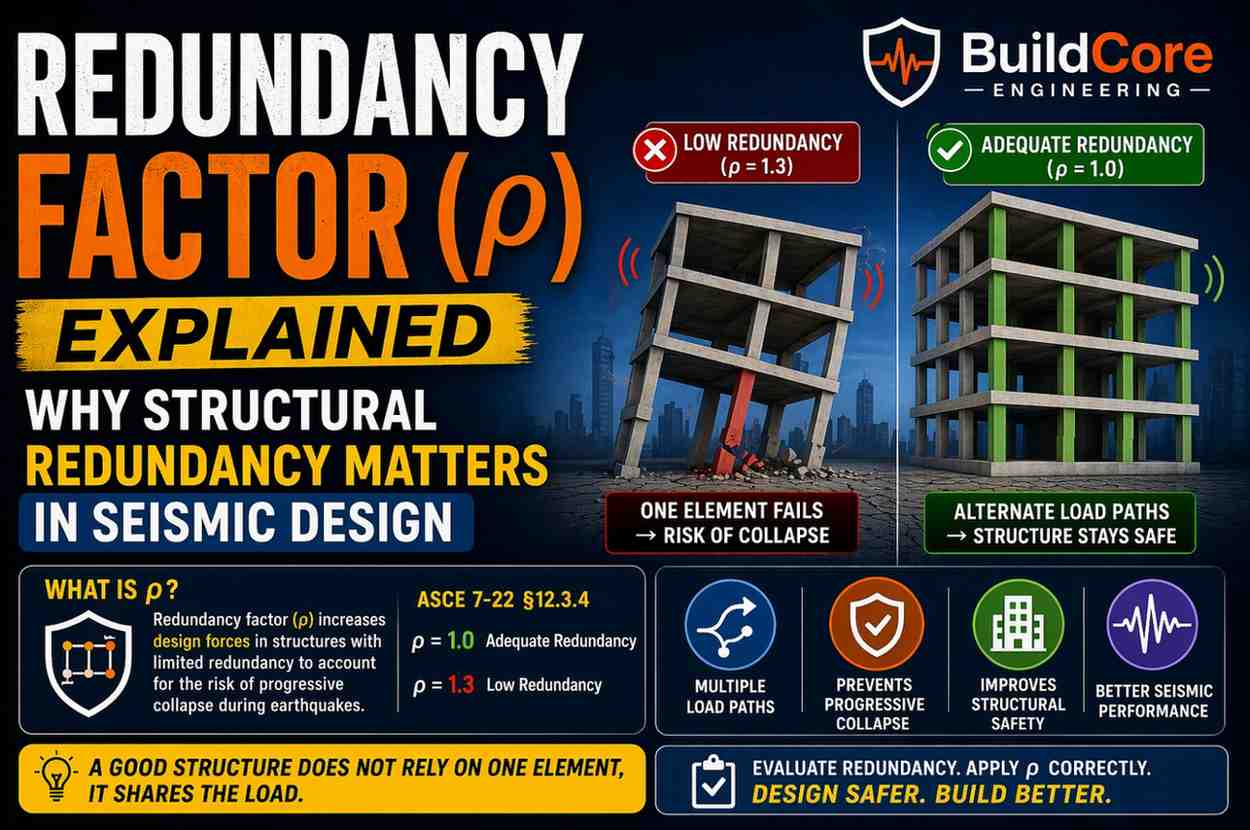
🧱 What is Redundancy?
Redundancy means:
👉 Having multiple load paths in a structure
So that:
- If one element fails
- Other elements can still carry the load
📘 Code Definition (ASCE 7)
As per ASCE 7-22 Section 12.3.4 (also ASCE 7-16):
The redundancy factor ( ) is used to increase design forces in structures with limited redundancy.
🎯 Values of Redundancy Factor
Typically:
- ( = 1.0 ) → Adequate redundancy
- ( = 1.3 ) → Low redundancy
⚠️ When ρ = 1.3 Applies
Higher redundancy factor is required when:
- Few lateral load-resisting elements
- Poor distribution of shear walls or frames
- Irregular layout
- Limited load paths
👉 This increases design forces for safety
🌀 Why Redundancy Matters
During earthquakes:
- Some elements may fail
- Damage may not be uniform
👉 A redundant system prevents progressive collapse
🏗️ Physical Meaning
Think of it like this:
👉 A bridge with multiple cables vs a single cable
- One cable fails → bridge still stands (redundant)
- Single cable fails → collapse
🔗 Related Concepts
👉 Seismic Load Path
👉 Overstrength Factor (Ω₀)
👉 Torsional Irregularity (Ax)
⚙️ Where ρ is Applied
Redundancy factor is applied to:
- Seismic design forces
- Member design
- Load combinations
📐 Load Combination Example
As per ASCE 7:
Where:
- = seismic effect
- = base seismic force
- = redundancy factor
🖥️ In ETABS
ETABS does NOT automatically determine redundancy factor.
👉 You must:
- Evaluate structural layout
- Identify redundancy level
- Apply ρ in load combinations manually
⚠️ Common Mistakes
- Ignoring redundancy in design
- Assuming all structures have ρ = 1
- Not checking load path continuity
- Over-reliance on software
🧠 How to Improve Redundancy
- Use multiple frames or shear walls
- Distribute lateral elements evenly
- Avoid single-line lateral systems
- Ensure continuous load path
🏁 Conclusion
Redundancy is a key factor in seismic safety.
- It ensures alternative load paths
- It reduces collapse risk
- It improves structural reliability
👉 ASCE 7 enforces redundancy through factor ρ to prevent unsafe designs.
👉 A good structure does not rely on one element — it shares the load
Latest Articles
Learn structural engineering concepts and practical insights
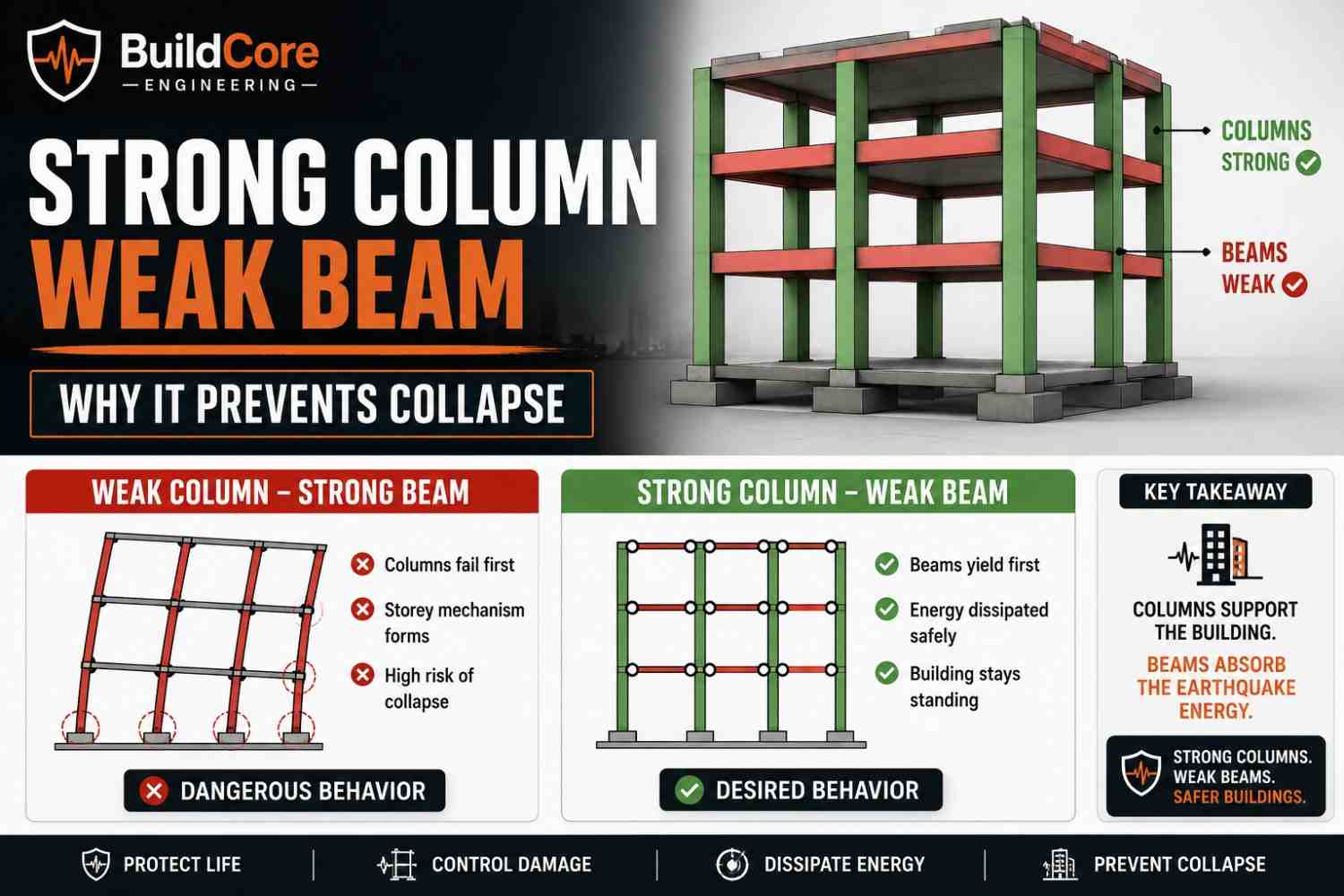
Strong Column Weak Beam Explained: The Most Important Rule in Earthquake Design
Learn what Strong Column Weak Beam means, why it is essential in seismic design, and how it prevents building collapse during earthquakes.

Common Mistakes Engineers Make in ETABS (And How to Avoid Them)
A practical guide to the most common ETABS modeling mistakes — from wrong mass source settings to incorrect diaphragm assumptions — and exactly how to fix them.
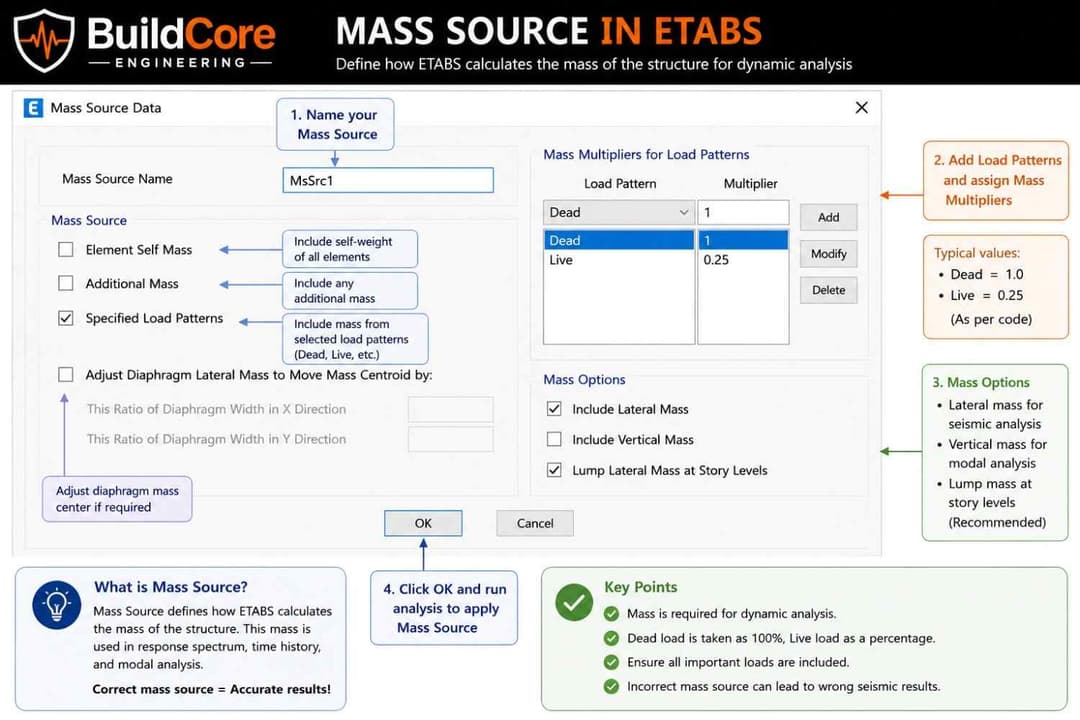
What is Mass Source in ETABS? A Simple Explanation for Structural Engineers
Learn what mass source is in ETABS, why it is important in seismic analysis, and how incorrect mass definition can lead to wrong results.