What is Overstrength Factor (Ω₀)? A Practical Guide for Structural Engineers
Published on 2024-11-25
In seismic design, engineers often focus on reducing forces using the Response Modification Factor (R). However, another equally important parameter is the Overstrength Factor (Ω₀).
While R reduces design forces, Ω₀ does the opposite—it ensures that certain elements are designed for higher forces to maintain structural integrity.
🧱 What is the Overstrength Factor (Ω₀)?

The Overstrength Factor (Ω₀) accounts for the actual strength of a structure being greater than its design strength.
In simple terms:
👉 Structures are usually stronger than what we design them for.
This happens due to:
- Material strength exceeding nominal values
- Conservative design assumptions
- Redundancy in structural systems
- Strain hardening of materials
🔍 Why Do We Need Ω₀?
During an earthquake:
- Some elements are expected to yield and dissipate energy
- Other elements must remain elastic and safe
Ω₀ ensures that critical components are strong enough to handle amplified forces.
📌 Key Purpose:
- Prevent premature failure
- Protect critical load paths
- Ensure ductile behavior occurs where intended
⚙️ Where is Ω₀ Used?
The overstrength factor is applied to non-ductile or critical elements, such as:
- Collectors (drag struts)
- Diaphragms
- Connections
- Foundations
- Anchorage systems
👉 These elements must remain elastic even when the main system yields.
📊 Typical Values of Ω₀ (ASCE 7)
| Structural System | Ω₀ Value |
|---|---|
| Special Moment Frames | 3 |
| Ordinary Moment Frames | 3 |
| Braced Frames | 2 – 3 |
| Shear Walls | 2 – 3 |
Values vary depending on system and code edition.
⚖️ Difference Between R and Ω₀
| Factor | Purpose |
|---|---|
| R | Reduces seismic forces (accounts for ductility) |
| Ω₀ | Increases forces for critical elements (accounts for overstrength) |
👉 Key Insight:
- R → Economy
- Ω₀ → Safety
Both work together to achieve a balanced design.
🌀 How Ω₀ Works in Design
Instead of using reduced forces:
Design Force = Reduced Force × Ω₀
Latest Articles
Learn structural engineering concepts and practical insights

Strong Column Weak Beam Explained: The Most Important Rule in Earthquake Design
Learn what Strong Column Weak Beam means, why it is essential in seismic design, and how it prevents building collapse during earthquakes.

Common Mistakes Engineers Make in ETABS (And How to Avoid Them)
A practical guide to the most common ETABS modeling mistakes — from wrong mass source settings to incorrect diaphragm assumptions — and exactly how to fix them.
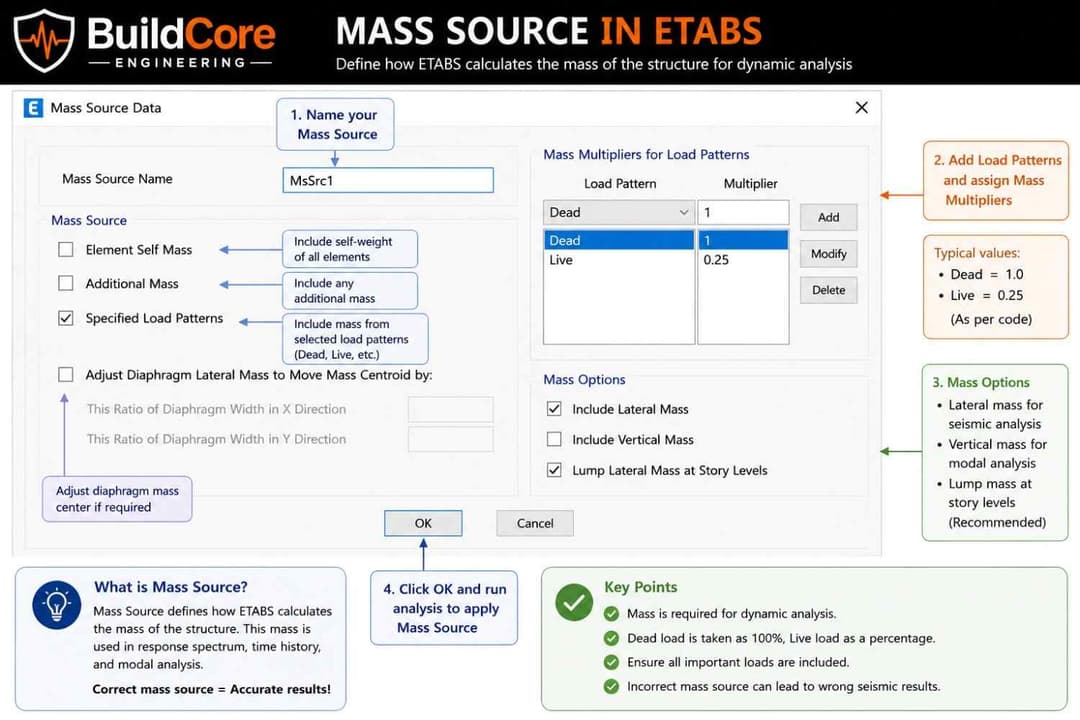
What is Mass Source in ETABS? A Simple Explanation for Structural Engineers
Learn what mass source is in ETABS, why it is important in seismic analysis, and how incorrect mass definition can lead to wrong results.