Why Overdesign Can Be Just as Dangerous as Underdesign
Published on 2026-04-25
In many structural failures, one thing is surprising:
Some elements remain perfectly intact…
while others fail suddenly.
The structure wasn’t too weak.
It was unbalanced.
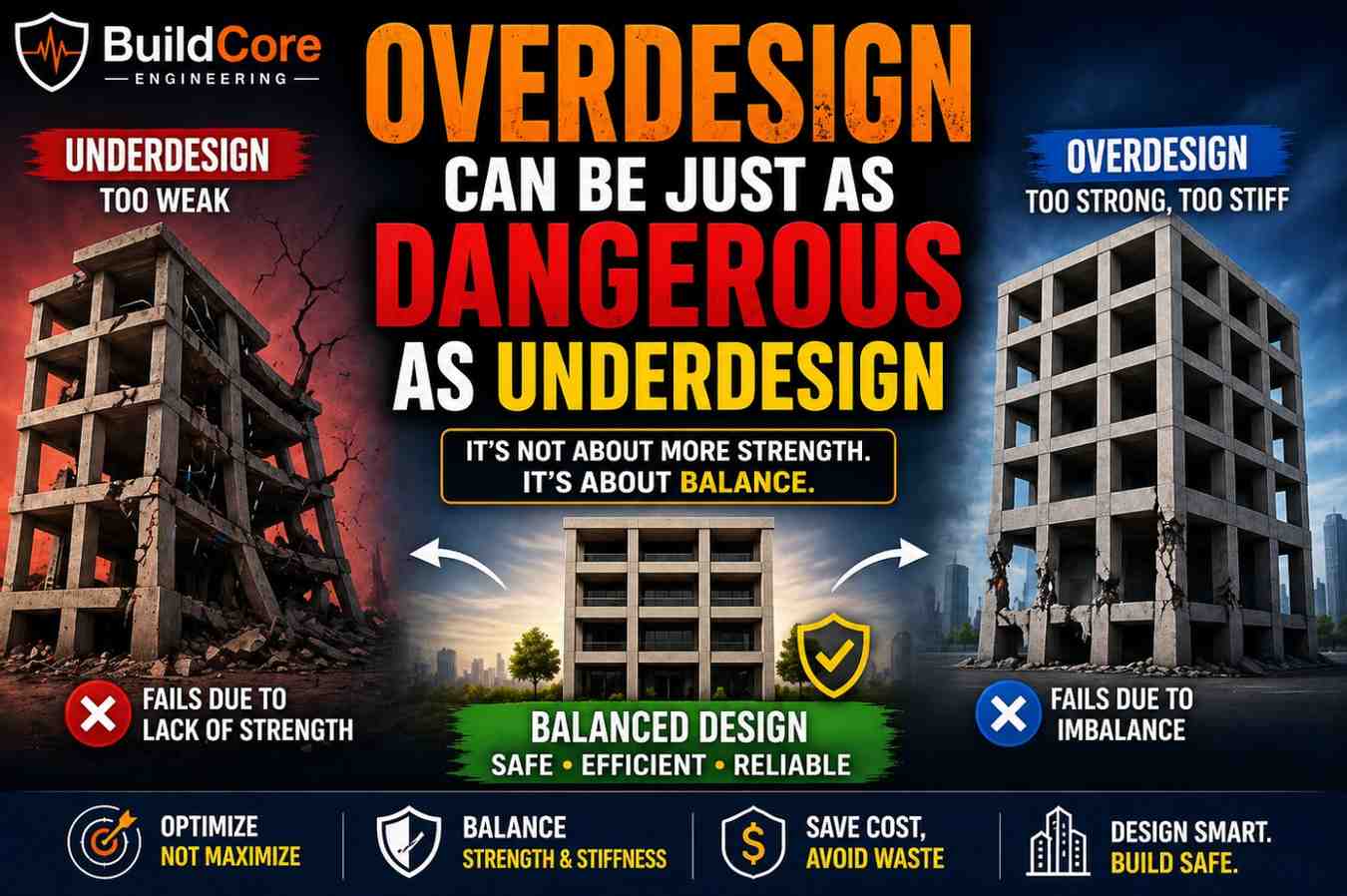
🧠 The Common Misconception
In engineering, there is a very common belief:
More strength means more safety.
So designers often add:
- More concrete
- More reinforcement
- Larger member sizes
At first glance, this feels safe.
But structural systems don’t behave that way.
⚠️ What is Overdesign?
Overdesign occurs when elements are provided with more strength or stiffness than required.
While this may seem conservative, it can introduce unintended problems into the structural system.
Because structures are not just collections of strong elements.
They are interconnected systems.
🔥 The Real Problem: Imbalance
A structure works best when its components are properly balanced.
When one part becomes too strong or too stiff compared to others, that balance is disturbed.
Forces do not distribute evenly anymore.
Instead, they shift toward weaker or more flexible elements.
This concentration of demand is where failure begins.
🧱 Example: Strong Beam – Weak Column
Consider a structure where beams are made excessively strong.
The columns, in comparison, become the weaker elements.
During extreme loading conditions:
- Beams remain intact
- Columns are forced to carry higher demand
This leads to column failure — which is far more dangerous and can trigger collapse.
🌀 Overdesign Can Increase Forces
A very stiff structure does not absorb energy efficiently.
Instead, it attracts higher forces during events like earthquakes.
Less flexibility means:
- Higher force demand
- Increased stress in members
- Reduced ability to dissipate energy
So instead of improving safety, overdesign can unintentionally increase risk.
⚠️ Loss of Ductility
Good structural design allows controlled deformation.
This ability to deform without failure is known as ductility.
When elements are overdesigned:
- They become too rigid
- They lose deformation capacity
This increases the likelihood of sudden, brittle failure — which is far more dangerous than controlled damage.
📉 Real-World Observation
In real earthquakes, buildings rarely fail everywhere at once.
Failure usually begins in specific locations:
- A particular story
- A set of columns
- A weak connection
This localized failure is often a result of imbalance in strength and stiffness.
⚖️ Underdesign vs Overdesign
| Underdesign | Overdesign | |
|---|---|---|
| Strength | Insufficient | Excessive |
| Behavior | Weak | Too rigid / imbalanced |
| Failure Type | Immediate | Sudden / localized |
| Risk Nature | Obvious | Hidden |
Both extremes move the structure away from safe behavior.
🧠 The Real Goal of Design
Structural engineering is not about maximizing strength.
It is about achieving balanced performance.
A well-designed structure is:
- Strong enough to resist loads
- Flexible enough to absorb energy
- Proportioned correctly for load distribution
🔗 Related Insight
👉 Why Drift is More Dangerous Than Force
⚠️ A Common Mistake
A frequent assumption is:
“If I add more material, the structure becomes safer.”
This is not always true.
Excess strength in the wrong place can disturb the entire system.
Design is not about adding more.
It is about adding correctly.
🎯 Key Takeaway
Underdesign is dangerous because it lacks strength.
Overdesign is dangerous because it creates imbalance.
Safe design lies between these two extremes.
🏁 Conclusion
Good structural design is not about making structures as strong as possible.
It is about ensuring they behave correctly under real conditions.
Too little strength leads to failure.
Too much strength, in the wrong place, leads to imbalance.
👉 The safest structures are not the strongest ones —
they are the most well-balanced.
🔗 Want to Learn More?
👉 Seismic Base Shear Calculation Explained
Latest Articles
Learn structural engineering concepts and practical insights
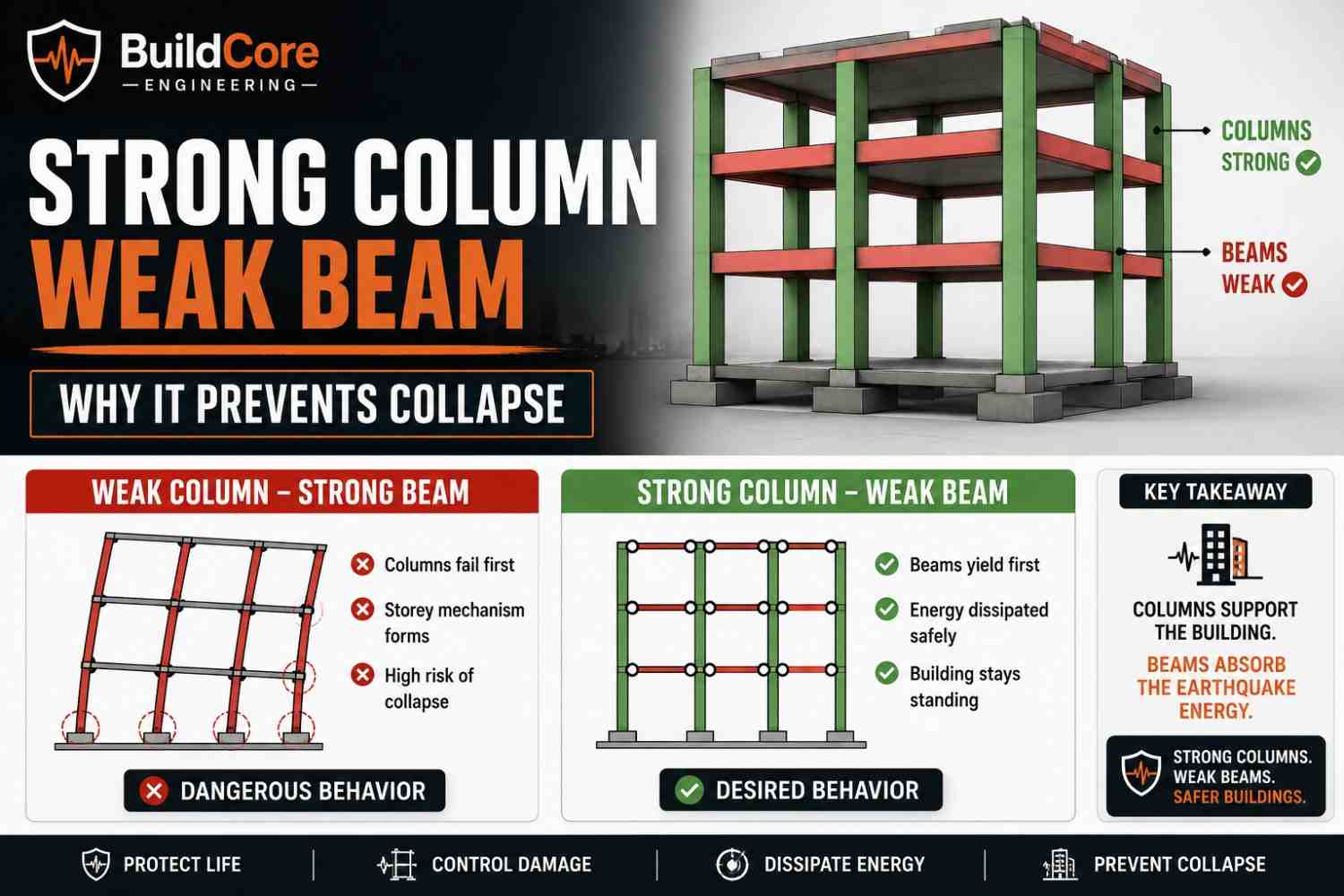
Strong Column Weak Beam Explained: The Most Important Rule in Earthquake Design
Learn what Strong Column Weak Beam means, why it is essential in seismic design, and how it prevents building collapse during earthquakes.
Common Mistakes Engineers Make in ETABS (And How to Avoid Them)
A practical guide to the most common ETABS modeling mistakes — from wrong mass source settings to incorrect diaphragm assumptions — and exactly how to fix them.
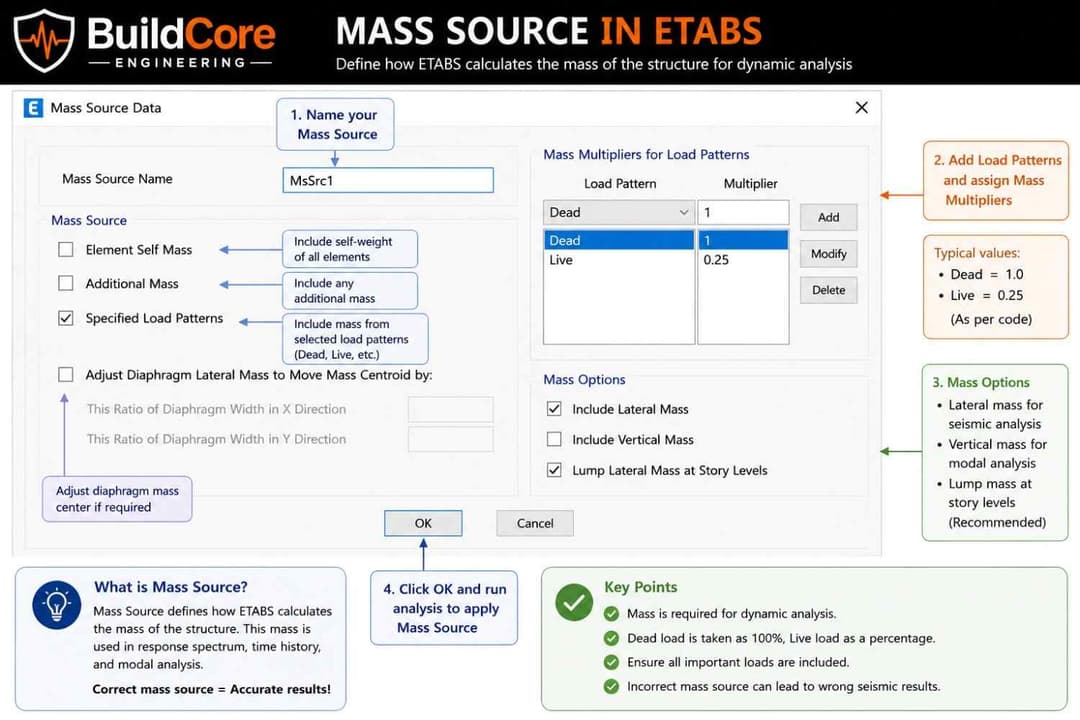
What is Mass Source in ETABS? A Simple Explanation for Structural Engineers
Learn what mass source is in ETABS, why it is important in seismic analysis, and how incorrect mass definition can lead to wrong results.