Torsional Irregularity in Buildings: What is Ax and Why It Matters?
Published on 2024-12-26
In seismic design, buildings do not always move uniformly.
👉 Some buildings twist.
This twisting behavior is called torsion, and when it becomes excessive, it leads to torsional irregularity — one of the most critical failure modes in earthquakes.
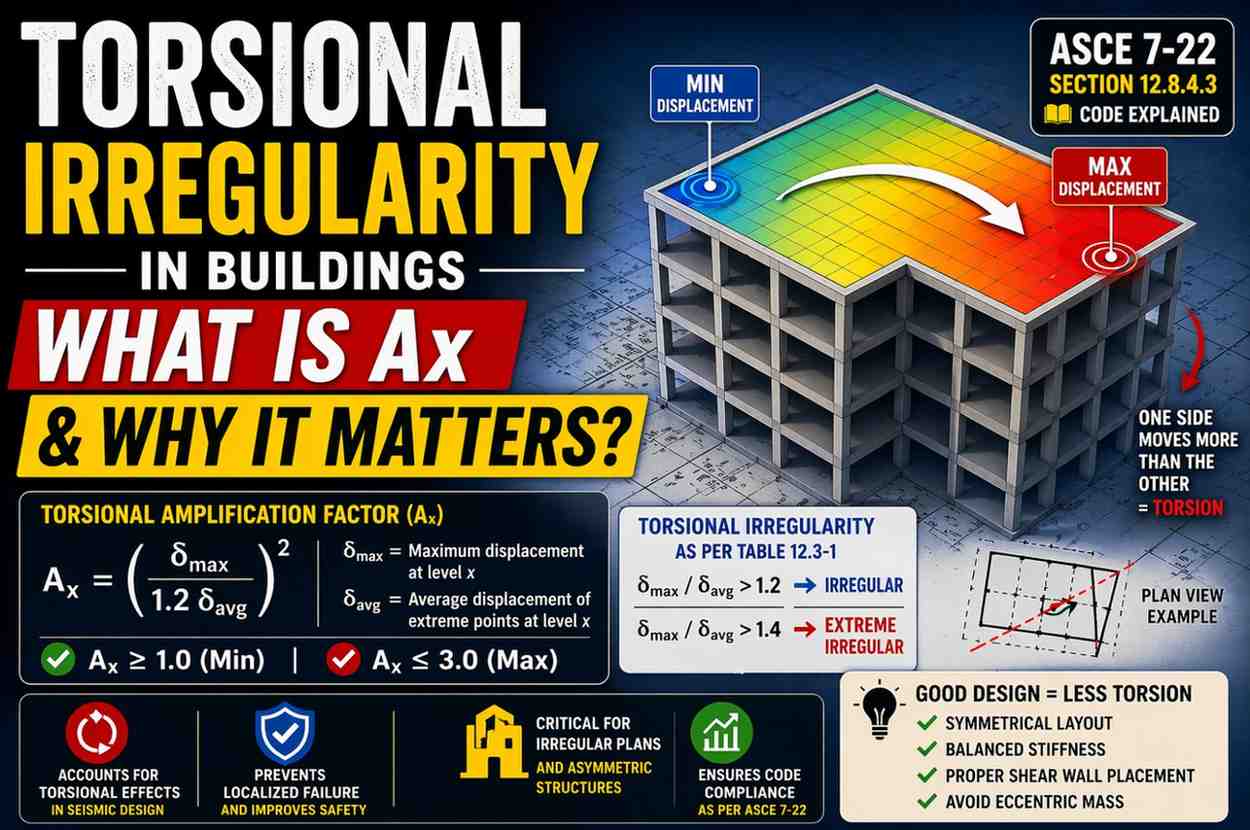
🧱 What is Torsional Irregularity?
Torsional irregularity occurs when:
👉 One side of the building displaces more than the other
This usually happens due to:
- Uneven stiffness
- Asymmetric mass distribution
- Irregular geometry
📘 Code Definition (ASCE 7)
As per ASCE 7-22 Table 12.3-1 (also ASCE 7-16 Table 12.3-1):
Torsional irregularity exists when:
Where:
- = Maximum story displacement
- = Average displacement of the story
⚠️ Extreme Torsional Irregularity
If:
👉 It is classified as extreme torsional irregularity
🌀 Torsional Amplification Factor (Ax)
As per ASCE 7-22 Section 12.8.4.3:
When torsional irregularity exists, torsional effects must be amplified using:
⚠️ Limits on Ax (Very Important)
As per ASCE 7-22 Section 12.8.4.3:
- ( A_x \ge 1.0 )
- ( A_x \le 3.0 )
👉 The amplification factor is capped at 3.0
🎯 What Does Ax Actually Do?
Ax amplifies:
- Accidental torsional moment
- Effects due to eccentricity
👉 It ensures that torsion is not underestimated in design
🏗️ Where Ax is Applied
Ax is used to amplify:
- Accidental eccentricity (±5%)
- Torsional moments at each level
👉 It is NOT applied directly to all forces
🧠 Physical Understanding
Imagine:
👉 One side of building moves more than the other
This causes:
- Rotation
- Stress concentration
- Overloaded columns on one side
👉 That is why amplification is required
🔗 Related Concepts
👉 Seismic Load Path
👉 Soft Story Irregularity
🖥️ Torsion Check in ETABS (Correct Method)
As per ASCE 7-22 Section 12.8.4.3:
-
Run seismic analysis with accidental eccentricity (±5%)
-
Obtain:
- Maximum displacement (( \delta_{max} ))
- Average displacement (( \delta_{avg} ))
-
Check torsional irregularity (Table 12.3-1):
- ( \delta_{max} / \delta_{avg} > 1.2 ) → Irregular
-
Calculate torsional amplification factor:
- Apply limits:
- ( A_x \ge 1.0 )
- ( A_x \le 3.0 )
👉 ETABS does not explicitly apply Ax — the engineer must verify torsional amplification requirements.
⚠️ Common Causes of Torsion
- Uneven column layout
- Offset shear walls
- Irregular floor plan (L-shape, U-shape)
- Mass concentration on one side
🧠 How to Reduce Torsional Effects
- Use symmetrical layout
- Balance stiffness distribution
- Place shear walls properly
- Avoid eccentric mass
⚠️ Common Mistakes
- Ignoring torsional irregularity
- Using incorrect Ax formula
- Not applying limits (1 to 3)
- Blindly trusting software
🏁 Conclusion
Torsional irregularity is one of the most dangerous behaviors in seismic design.
- It causes uneven displacement
- It amplifies internal forces
- It can lead to localized failure
👉 As per ASCE 7-22, torsional effects must be carefully evaluated and amplified when required.
👉 Good design minimizes torsion at the planning stage — not after analysis
Latest Articles
Learn structural engineering concepts and practical insights
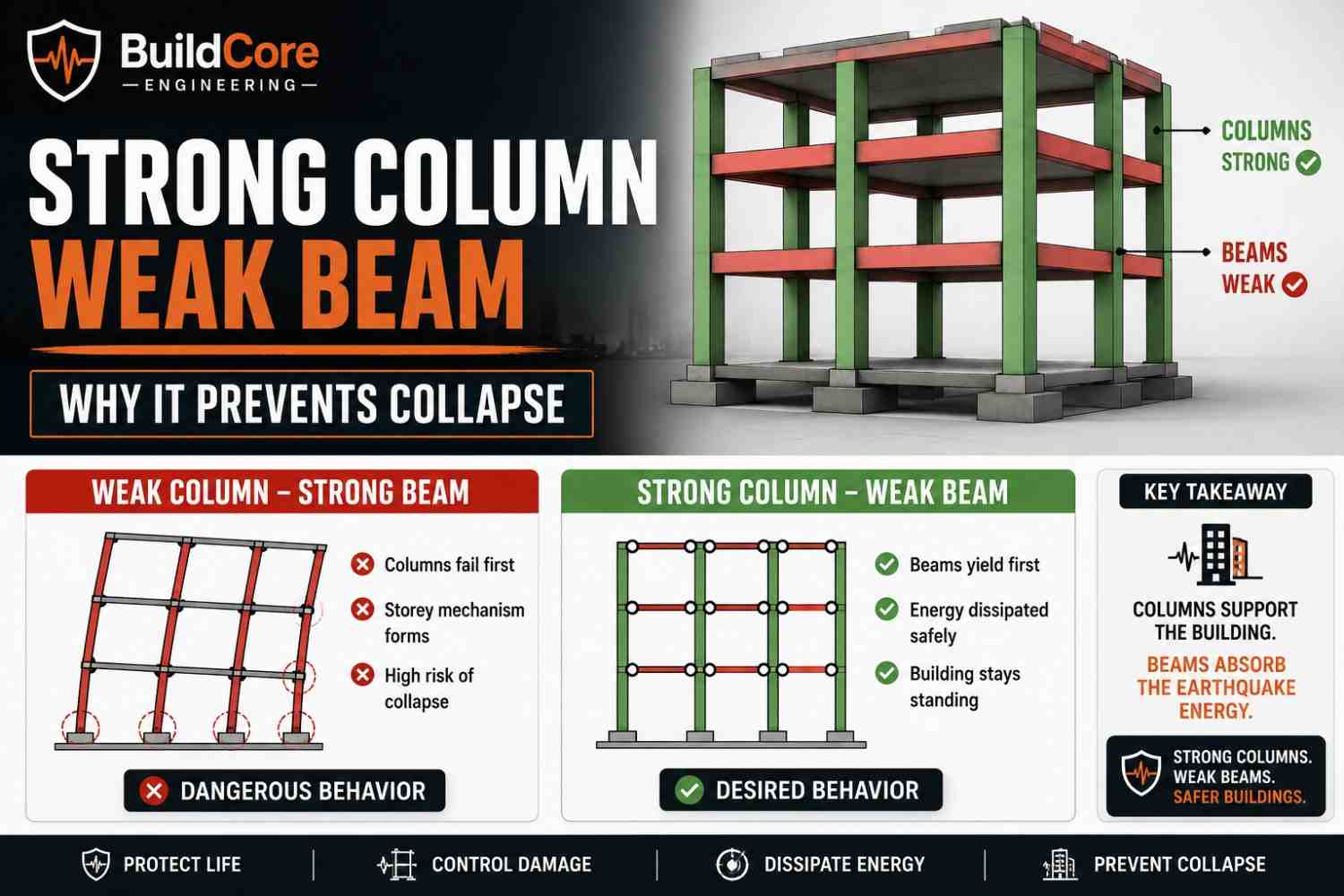
Strong Column Weak Beam Explained: The Most Important Rule in Earthquake Design
Learn what Strong Column Weak Beam means, why it is essential in seismic design, and how it prevents building collapse during earthquakes.
Common Mistakes Engineers Make in ETABS (And How to Avoid Them)
A practical guide to the most common ETABS modeling mistakes — from wrong mass source settings to incorrect diaphragm assumptions — and exactly how to fix them.
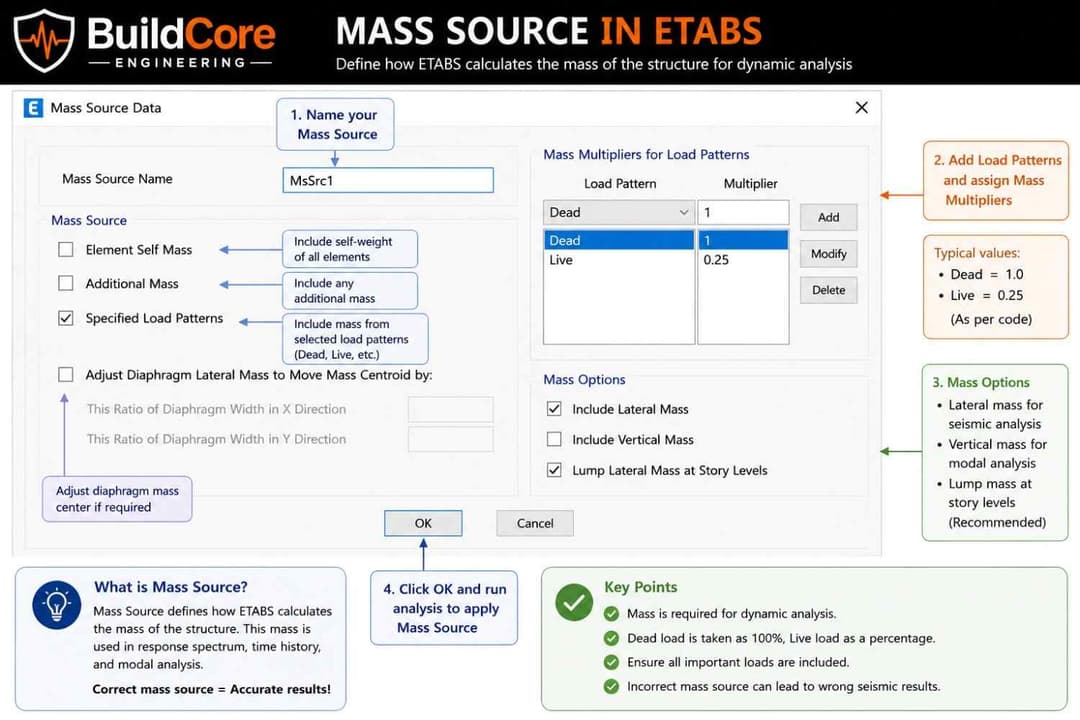
What is Mass Source in ETABS? A Simple Explanation for Structural Engineers
Learn what mass source is in ETABS, why it is important in seismic analysis, and how incorrect mass definition can lead to wrong results.