Soft Story Irregularity: Why It Causes Building Collapse in Earthquakes
Published on 2024-12-10
In earthquake engineering, one of the most dangerous structural configurations is a soft story.
Many real-world building collapses have been directly linked to this issue.
👉 Understanding soft story irregularity is critical for safe structural design.
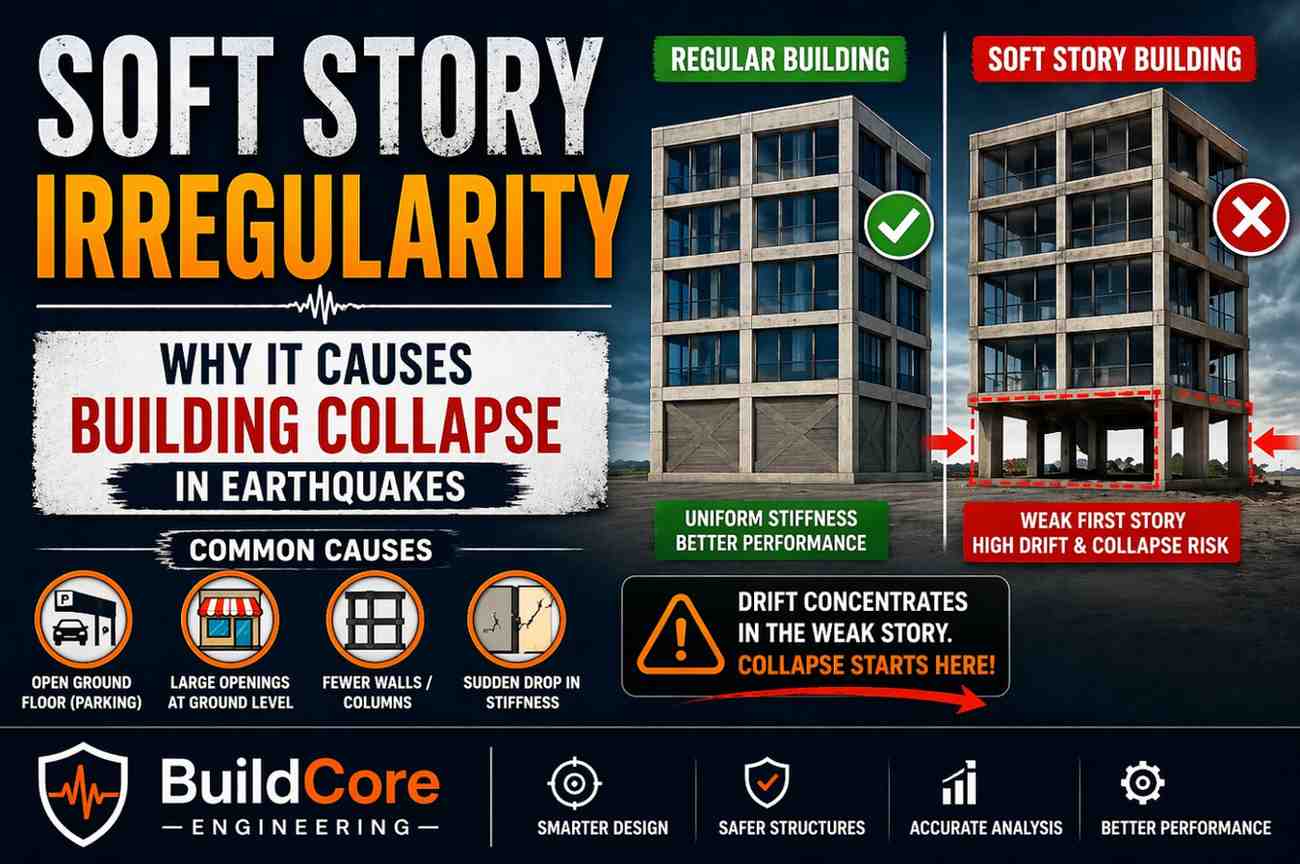
Soft story failure typically occurs at the weakest level (usually ground floor).
🧱 What is a Soft Story?
A soft story is a level in a building that has significantly lower stiffness compared to the stories above.
📌 In simple terms:
👉 One floor is much more flexible than the others
⚙️ Code Definition (ASCE 7)
A story is considered soft when:
OR
🌀 Why Soft Story is Dangerous
During an earthquake:
- Upper floors remain relatively stiff
- Soft story deforms excessively
👉 This leads to:
- Large concentration of drift
- Formation of plastic hinges
- Sudden collapse mechanism
⚠️ Common Examples of Soft Story
- Open ground floor (parking area)
- Buildings with large glass openings
- Commercial ground floors with fewer walls
- Weak column–strong beam configurations
📊 Structural Behavior
In a soft story building:
- Drift is concentrated in one level
- Columns experience high bending demand
- Failure occurs at that level first
👉 Collapse often starts from the soft story
🏗️ Real Earthquake Observations
Many past earthquakes have shown:
- Buildings collapse at ground floor
- Upper floors remain relatively intact
👉 This is a classic soft story failure pattern
🖥️ How to Identify Soft Story in ETABS
- Check story stiffness output
- Compare stiffness between floors
- Identify sudden drop in stiffness
👉 Also review story drift plots
🧠 How to Fix Soft Story Problem
- Add shear walls at weak level
- Increase column stiffness
- Use bracing systems
- Avoid open ground floor without strengthening
⚠️ Common Mistakes
- Ignoring stiffness variation between floors
- Providing open parking without reinforcement
- Focusing only on strength, not stiffness
- Not checking drift concentration
🏁 Conclusion
Soft story irregularity is one of the most critical causes of structural failure during earthquakes.
- It leads to concentration of deformation
- It increases collapse risk
- It must be carefully addressed in design
👉 A building is only as strong as its weakest story
Latest Articles
Learn structural engineering concepts and practical insights
Strong Column Weak Beam Explained: The Most Important Rule in Earthquake Design
Learn what Strong Column Weak Beam means, why it is essential in seismic design, and how it prevents building collapse during earthquakes.

Common Mistakes Engineers Make in ETABS (And How to Avoid Them)
A practical guide to the most common ETABS modeling mistakes — from wrong mass source settings to incorrect diaphragm assumptions — and exactly how to fix them.
What is Mass Source in ETABS? A Simple Explanation for Structural Engineers
Learn what mass source is in ETABS, why it is important in seismic analysis, and how incorrect mass definition can lead to wrong results.