Why Drift is More Dangerous Than Force in Buildings
Published on 2025-01-04
During an earthquake, not all buildings collapse immediately.
Some stand for a few seconds — bending, cracking, and then suddenly failing.
So what causes that delay?
It’s not just force.
It’s movement.
More specifically:
👉 Drift — the real hidden danger
🧠 What is Drift?
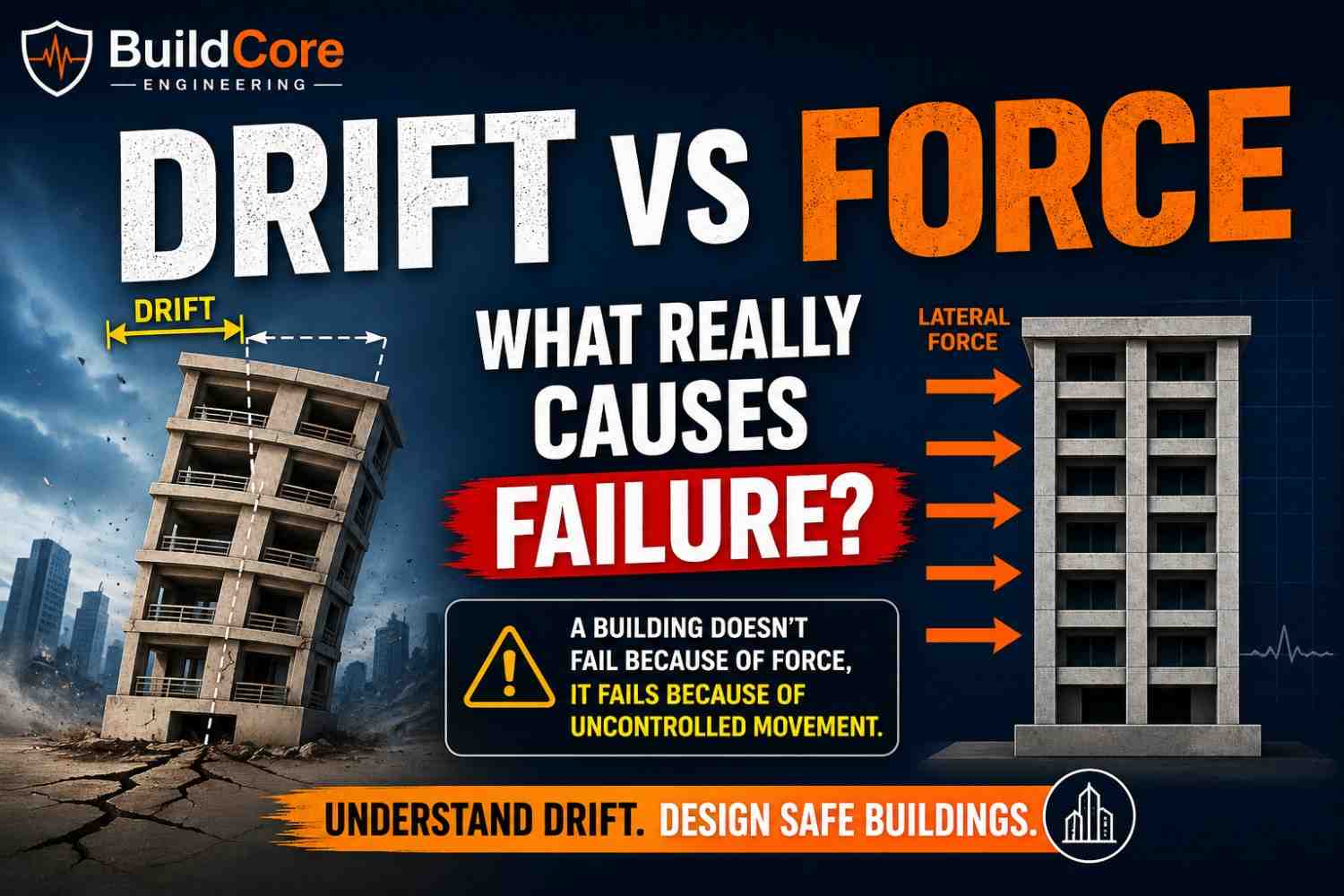
When a building is subjected to lateral forces such as wind or earthquakes, it does not remain perfectly rigid.
Instead, it moves sideways.
This sideways movement is called drift.
You can imagine a tall building like a flexible vertical element. When pushed from the side, it bends before it breaks. That bending is where the real problem begins.
⚠️ Why Force Alone Doesn’t Define Safety
In structural design, most people focus on force.
“How much load can the building resist?”
But strength alone does not guarantee safety.
A building can be strong enough to resist large forces, yet still fail due to excessive movement.
👉 Strength without control of deformation is not enough.
🔥 The Real Problem: Excessive Drift
When drift becomes too large, damage begins to develop gradually.
Cracks start forming in walls.
Structural elements begin to lose stiffness.
Connections weaken over time.
As stiffness reduces, the building becomes even more flexible, which increases movement further.
This creates a dangerous cycle that can eventually lead to failure.
🧱 What Fails First in Real Structures?
In actual buildings, failure does not occur instantly.
It progresses.
Walls crack first.
Beams experience excessive bending.
Columns carry increasing stress.
Connections begin to deteriorate.
By the time collapse happens, the structure has already undergone significant internal damage.
🌀 Why Drift is More Dangerous Than Force
Force is immediate.
Drift is progressive.
That is what makes it more dangerous.
Force applies load to a structure, but drift reflects how the structure responds to that load over time.
👉 It is the response — not just the load — that determines failure.
📉 What Engineers Actually Check
Modern structural design does not rely only on strength checks.
Engineers carefully control movement by evaluating:
- Story drift
- Interstory drift ratio
- Deflection limits
In many cases, drift governs the design more than force.
🔗 Related Insight
👉 Why Buildings Collapse During Earthquakes
⚠️ Common Misunderstanding
A common assumption is:
“If forces are within limits, the design is safe.”
This is not always true.
A structure can pass all force checks and still be unsafe due to excessive drift.
🧠 Real-World Observation
In many earthquakes, buildings do not collapse immediately.
They first deform, then weaken, and finally fail.
That deformation is drift.
🎯 Key Takeaway
Force tells you how strong a building is.
Drift tells you how it behaves.
And in structural engineering, behavior determines safety.
🏁 Conclusion
Structural safety is not just about resisting loads.
It is about controlling how a structure moves under those loads.
Because buildings do not simply resist forces — they respond to them.
And uncontrolled movement is what leads to failure.
🔗 Want to Learn More?
👉 Seismic Base Shear Calculation Explained
Latest Articles
Learn structural engineering concepts and practical insights
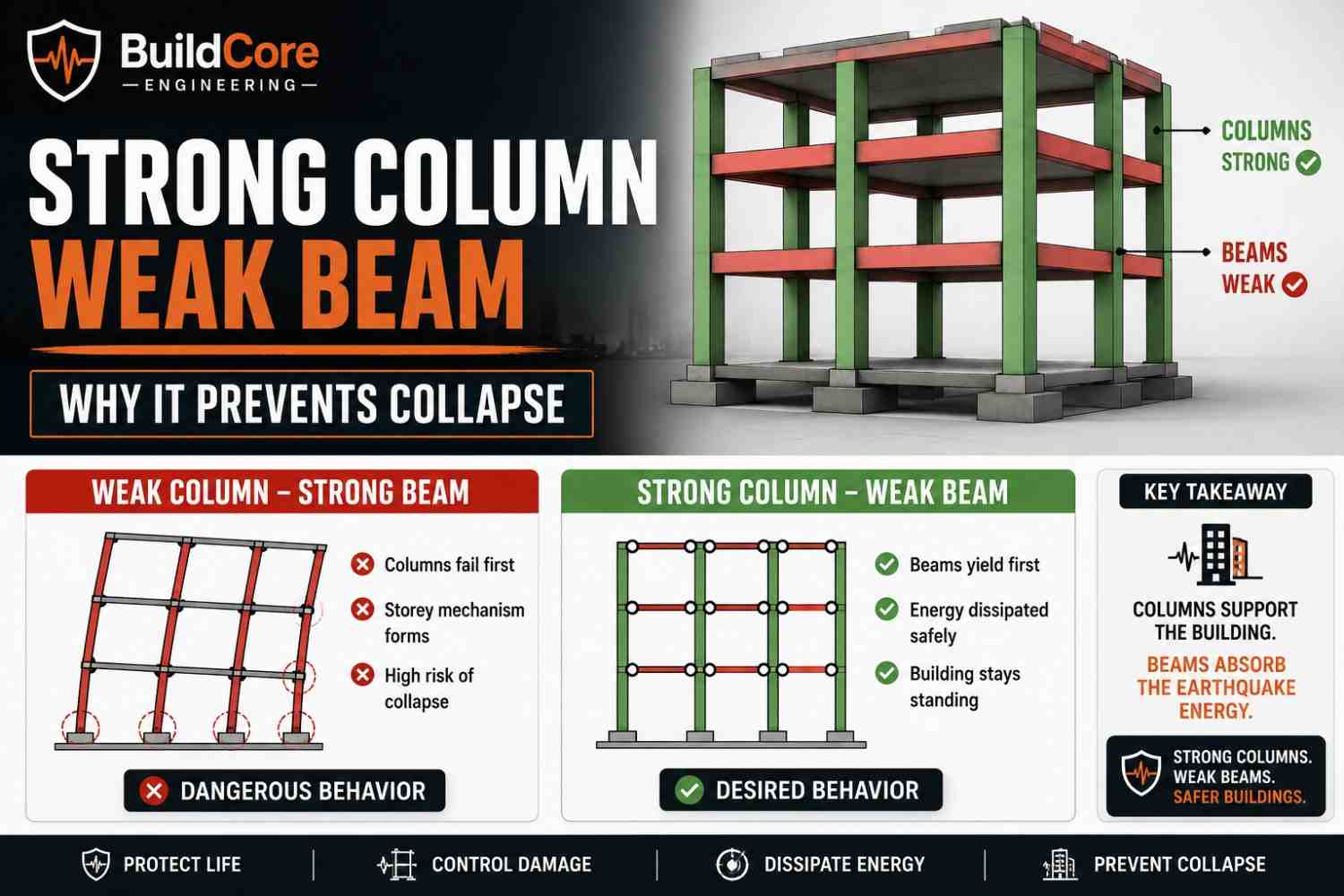
Strong Column Weak Beam Explained: The Most Important Rule in Earthquake Design
Learn what Strong Column Weak Beam means, why it is essential in seismic design, and how it prevents building collapse during earthquakes.

Common Mistakes Engineers Make in ETABS (And How to Avoid Them)
A practical guide to the most common ETABS modeling mistakes — from wrong mass source settings to incorrect diaphragm assumptions — and exactly how to fix them.

What is Mass Source in ETABS? A Simple Explanation for Structural Engineers
Learn what mass source is in ETABS, why it is important in seismic analysis, and how incorrect mass definition can lead to wrong results.