How to Calculate Seismic Base Shear (Step-by-Step as per ASCE 7)
Published on 2024-12-18
Seismic base shear is one of the most fundamental calculations in earthquake engineering.
👉 It represents the total lateral force that a structure must resist during an earthquake.
Understanding how to calculate base shear is essential for every structural engineer.

🧱 What is Seismic Base Shear?
Base shear (V) is the total horizontal force at the base of a structure due to earthquake loading.
👉 It is the starting point for distributing forces throughout the structure.
⚙️ Basic Formula (ASCE 7)
The base shear is calculated as:
Where:
- ( V ) = Base shear
- ( C_s ) = Seismic response coefficient
- ( W ) = Effective seismic weight
🌀 Step-by-Step Calculation
🔹 Step 1: Determine Seismic Design Category (SDC)
Before calculating base shear, determine the Seismic Design Category (SDC).
👉 Use our calculator:
BuildCore SDC Calculator
SDC controls:
- Analysis method (ELF or RSA)
- Detailing requirements
🔹 Step 2: Determine Spectral Accelerations
From seismic maps:
- ( S_s ) = Short-period spectral acceleration
- ( S_1 ) = 1-second spectral acceleration
🔹 Step 3: Apply Site Coefficients
Calculate:
Then:
🔹 Step 4: Calculate Seismic Response Coefficient (Cₛ)
Where:
- ( R ) = Response Modification Factor
- ( I_e ) = Importance factor
👉 Learn more about R here:
Response Modification Factor (R)
🔹 Step 5: Apply Limits on Cₛ
ASCE 7 defines upper and lower bounds:
- Minimum base shear ensures safety
- Prevents underestimation
🔹 Step 6: Calculate Effective Seismic Weight (W)
Includes:
- Dead load
- Portion of live load
- Equipment loads
🔹 Step 7: Compute Base Shear
👉 This is your final design base shear.
⚖️ ELF vs RSA
- ELF → Simplified method
- RSA → Dynamic analysis
👉 Learn more here:
ELF vs Response Spectrum Analysis
⚠️ Important Design Insights
- Base shear is a global value
- It must be distributed vertically
- It depends heavily on R and SDC
👉 Wrong inputs = wrong design forces
🖥️ Base Shear in ETABS
In ETABS:
- Automatically calculated from input parameters
- Must be verified manually
👉 Always compare with hand calculation
🧠 Practical Engineering Tips
- Always double-check SDC
- Verify seismic parameters
- Use correct R value
- Cross-check software results
⚠️ Common Mistakes
- Using incorrect seismic data
- Ignoring importance factor
- Wrong R value
- Not applying code limits
🏁 Conclusion
Seismic base shear is the foundation of earthquake-resistant design.
- It defines total lateral demand
- It depends on multiple parameters
- It must be calculated carefully
👉 Accurate base shear = reliable structural design
Latest Articles
Learn structural engineering concepts and practical insights

Strong Column Weak Beam Explained: The Most Important Rule in Earthquake Design
Learn what Strong Column Weak Beam means, why it is essential in seismic design, and how it prevents building collapse during earthquakes.

Common Mistakes Engineers Make in ETABS (And How to Avoid Them)
A practical guide to the most common ETABS modeling mistakes — from wrong mass source settings to incorrect diaphragm assumptions — and exactly how to fix them.
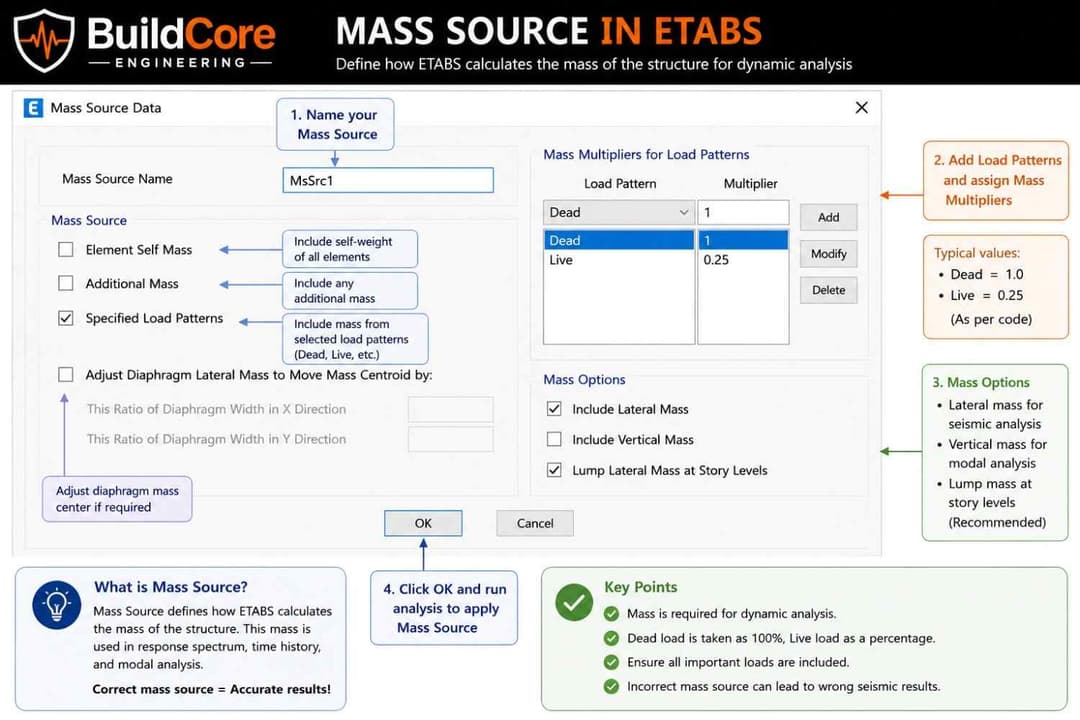
What is Mass Source in ETABS? A Simple Explanation for Structural Engineers
Learn what mass source is in ETABS, why it is important in seismic analysis, and how incorrect mass definition can lead to wrong results.