ELF vs. Response Spectrum Analysis: Which Method Should You Use in Seismic Design?
Published on 2024-12-31
In seismic design, one of the most important decisions engineers face is:
👉 Should I use ELF or Response Spectrum Analysis (RSA) in seismic design?
Choosing the wrong method can lead to:
- Unsafe design
- Over-conservative results
- Incorrect force distribution
Let’s break it down clearly.
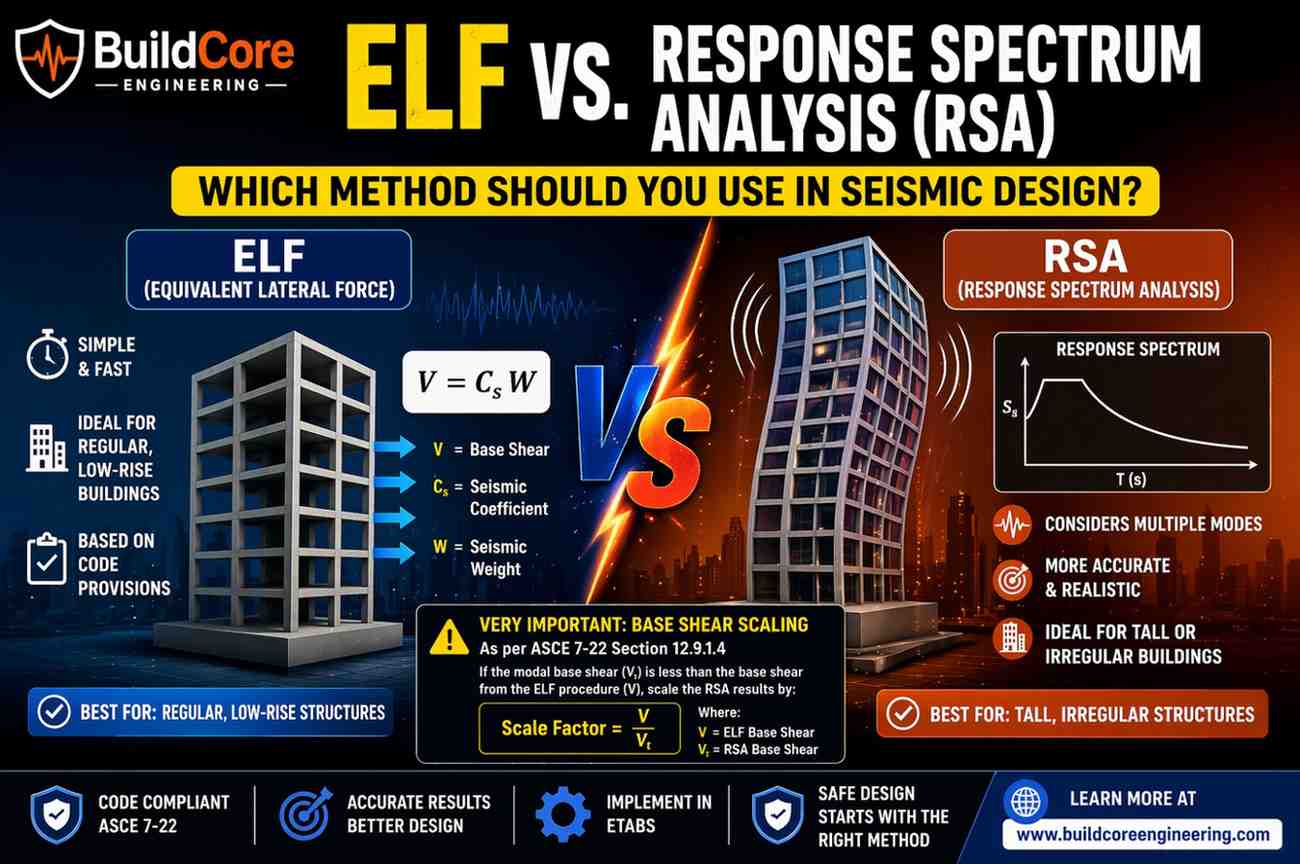
🧱 What is ELF (Equivalent Lateral Force Method)?
ELF is a simplified static method used to estimate seismic forces.
👉 It converts dynamic earthquake effects into equivalent static forces.
📐 Base Shear Equation
Where:
- = base shear
- = seismic coefficient
- = seismic weight
🎯 Key Features of ELF
- Simple and fast
- Suitable for regular, low-rise buildings
- Based on empirical code provisions
- Assumes first mode dominance
🌀 What is Response Spectrum Analysis (RSA)?
RSA is a dynamic analysis method that considers multiple vibration modes.
👉 It provides a more realistic representation of structural behavior during earthquakes.
🎯 Key Features of RSA
- Considers multiple modes
- Captures higher mode effects
- More accurate for complex structures
- Essential for irregular or tall buildings
📘 Code Requirements (ASCE 7-22)
As per ASCE 7-22 Section 12.6:
✔ ELF is allowed when:
- Structure is regular
- Height is within code limits
✔ RSA is required when:
- Structure is irregular
- Building is tall
- Higher mode effects are significant
⚖️ ELF vs RSA — Direct Comparison
| Feature | ELF | RSA |
|---|---|---|
| Type | Static | Dynamic |
| Complexity | Simple | Advanced |
| Accuracy | Approximate | Realistic |
| Modes | Single | Multiple |
| Use case | Regular, low-rise | Tall, irregular |
⚠️ VERY IMPORTANT: Base Shear Scaling
As per ASCE 7-22 Section 12.9.1.4:
If the modal base shear () is less than the base shear calculated using the Equivalent Lateral Force (ELF) procedure (), the response spectrum results must be scaled by:
Where:
- = ELF base shear
- = base shear from response spectrum analysis
👉 This ensures that dynamic analysis does not underestimate seismic forces.
🔗 Learn More:
👉 Why RSA Base Shear Must Be Adjusted
🧠 Why RSA Base Shear Must Be Scaled
Because RSA can sometimes:
- Underestimate forces
- Miss higher mode contributions
- Reduce forces due to modal combination
👉 That’s why ELF acts as a minimum safety benchmark
🖥️ ELF vs RSA in ETABS
ELF:
- Define static seismic load
- ETABS distributes forces automatically
RSA:
- Define response spectrum
- Assign mass source
- Run modal analysis
- Combine modes using SRSS or CQC
🔗 Related Topic:
👉 Learn more about how base shear is calculated in detail: * *Seismic Base Shear Calculation Explained**.
🔗 Important Related Concepts
👉 Response Modification Factor (R)
👉 Redundancy Factor ()
👉 Torsional Irregularity (Ax)
👉 Accidental Eccentricity (±5%)
🧠 Practical Understanding
👉 ELF provides a simplified estimate of seismic forces
👉 RSA captures the actual dynamic behavior of structures
Think of it like:
- ELF → Approximation
- RSA → Simulation
⚠️ Common Mistakes
- Using ELF for irregular structures
- Not scaling RSA base shear
- Ignoring torsional effects
- Blindly trusting software
🎯 When Should You Use Each?
✔ Use ELF when:
- Building is low-rise
- Structure is regular
- Preliminary design stage
✔ Use RSA when:
- Building is tall
- Structure is irregular
- Higher accuracy is required
🚀 Pro Tip
👉 Even if RSA is used:
👉 Always compare results with ELF
👉 This ensures code compliance and safety
🏁 Conclusion
Both ELF and RSA are essential tools in seismic design.
- ELF provides simplicity
- RSA provides accuracy
👉 The best engineers know when to use each method
👉 Use ELF for simplicity, RSA for reliability
🔗 Try This Tool
To determine your seismic design category:
👉 Use BuildCore SDC Calculator
Latest Articles
Learn structural engineering concepts and practical insights

Strong Column Weak Beam Explained: The Most Important Rule in Earthquake Design
Learn what Strong Column Weak Beam means, why it is essential in seismic design, and how it prevents building collapse during earthquakes.
Common Mistakes Engineers Make in ETABS (And How to Avoid Them)
A practical guide to the most common ETABS modeling mistakes — from wrong mass source settings to incorrect diaphragm assumptions — and exactly how to fix them.
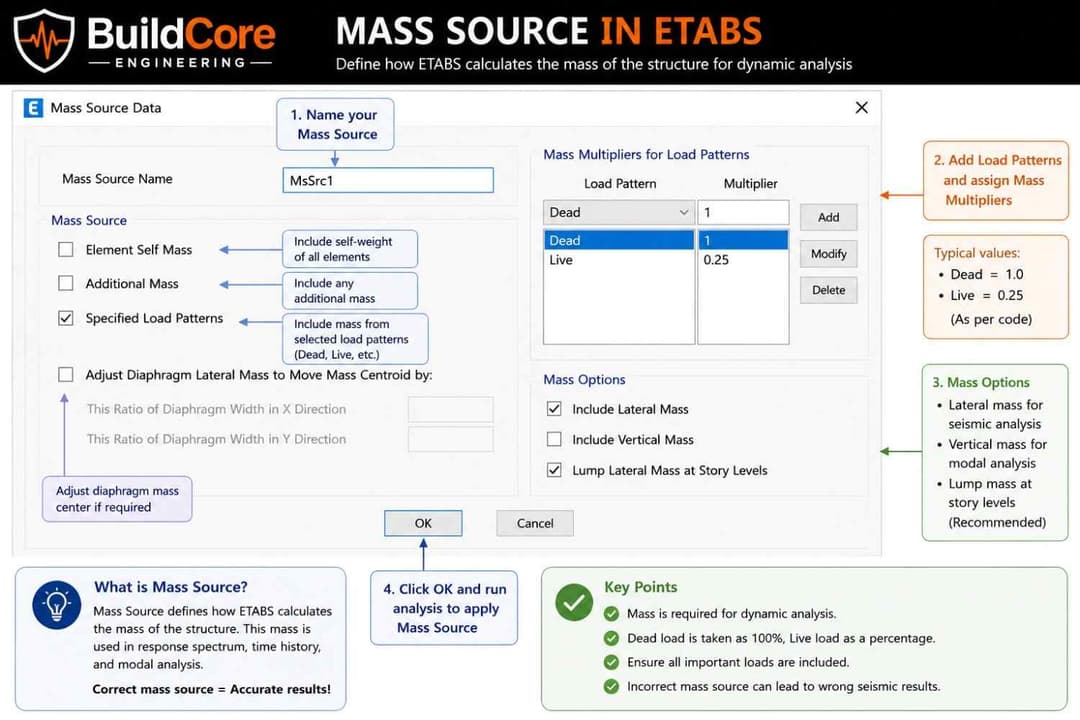
What is Mass Source in ETABS? A Simple Explanation for Structural Engineers
Learn what mass source is in ETABS, why it is important in seismic analysis, and how incorrect mass definition can lead to wrong results.