What is Mass Source in ETABS? A Simple Explanation for Structural Engineers
Published on 2026-05-19
In ETABS, one of the most important — and most misunderstood — concepts is the Mass Source. Many engineers define loads correctly, apply combinations meticulously, and then overlook one critical setting that can silently invalidate their entire seismic analysis.
The core question: Where does ETABS get its seismic mass from? Define it incorrectly, and every response spectrum result, every modal period, and every base shear value will be wrong — even if the model looks perfectly fine on screen.
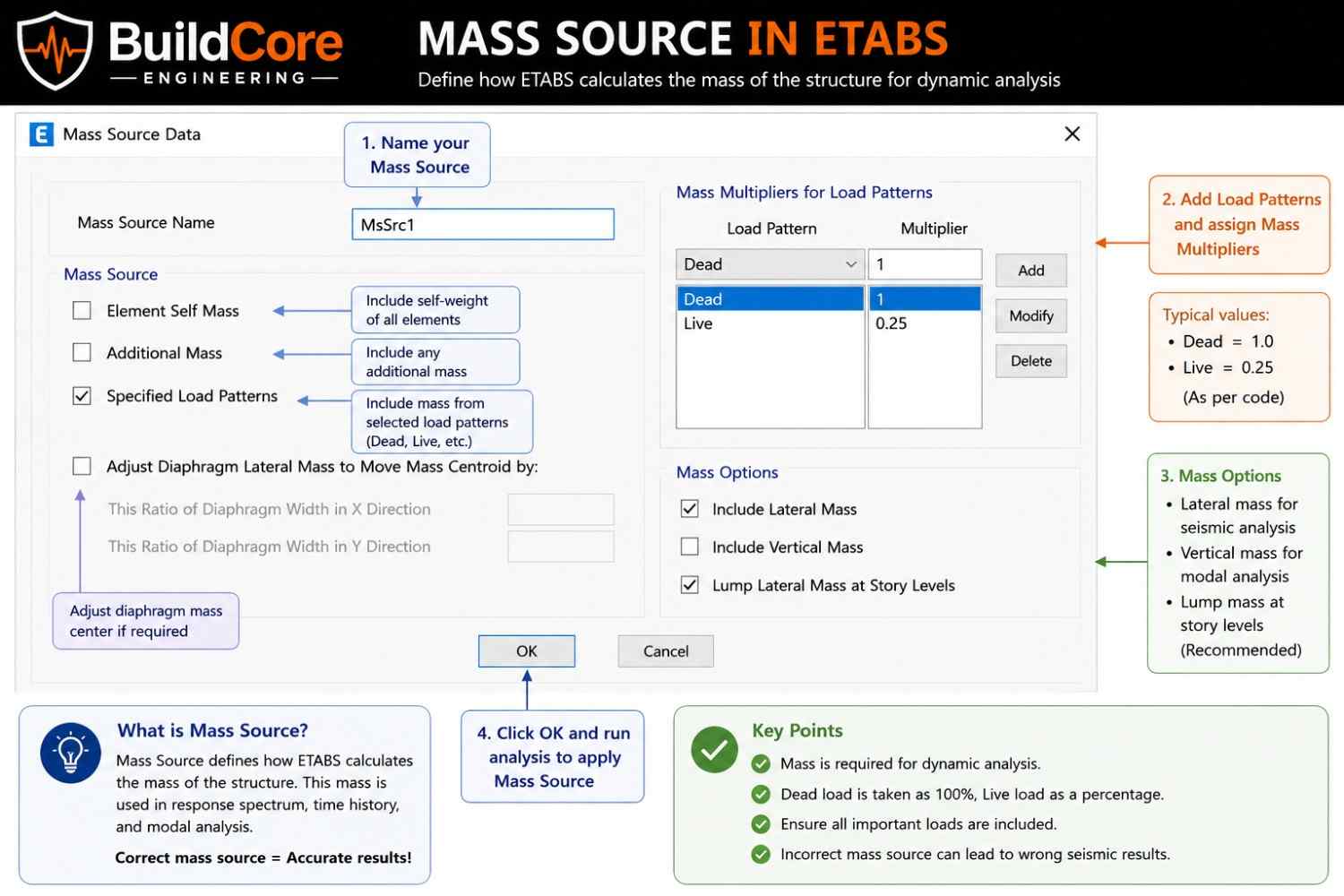
What is Mass Source in ETABS?
Mass Source is the setting that tells ETABS how to calculate the total seismic mass of your structure. This mass feeds directly into:
- Response Spectrum Analysis (RSA) — the backbone of modern seismic design
- Time History Analysis — for dynamic loading scenarios
- Modal Analysis — determining natural periods and mode shapes
- Equivalent Static Force — base shear calculations
ETABS does not automatically "know" which loads contribute to seismic mass. You must explicitly define it.
Why Does Mass Matter So Much?
The relationship is fundamental and unforgiving. Earthquake forces are governed by Newton's second law:
Where:
| Symbol | Meaning |
|---|---|
| Seismic force on the structure | |
| Seismic mass (defined by Mass Source) | |
| Ground acceleration (from response spectrum) |
There is no ambiguity: wrong mass → wrong seismic force → unconservative or over-conservative design. The spectral acceleration is fixed by your site and hazard level. The only variable you control is mass.
What Loads Should Be Included?
ETABS converts selected load cases into seismic mass using a multiplier per load case. The percentages below reflect common engineering practice and code intent:
| Load Type | Typical Mass Participation | Rationale |
|---|---|---|
| Dead Load (DL) | 100% | Always present; full contribution |
| Superimposed Dead (SDL) | 100% | Permanent — finishes, MEP, cladding |
| Live Load (LL) | 25% (typical) | Partial occupancy assumption |
| Partition Load | 100% or per code | Treated as dead if permanent |
| Roof Live Load | 0–20% | Rarely present during a seismic event |
📘 Code Reference — ASCE 7-22 Effective Seismic Weight
As per ASCE 7-22 Section 12.7.2 — Effective Seismic Weight, the effective seismic weight () of a structure must include all significant permanent and applicable live loads above the base.
This includes:
- Dead loads
- Permanent equipment and machinery
- Partition loads
- Portions of storage live loads
- Roof loads where required
- Fluids and bulk materials present during normal operation
🔹 Important ASCE 7-22 Requirements
✔ Storage Areas
A minimum of 25% of floor live load must be included in seismic weight for storage occupancies.
✔ Partition Loads
Where partitions exist (or may exist), the actual partition weight or a minimum of:
must be included.
✔ Permanent Equipment
The total operating weight of permanent equipment must be included in seismic mass.
✔ Roof Snow Load
When flat roof snow load exceeds:
at least 15% of the design snow load must be included.
What Goes Wrong With an Incorrect Mass Source?
⚠️ Warning: ETABS will complete the analysis and produce plausible-looking results with no warning message. There is no error for a misconfigured Mass Source — only potentially unsafe results.
Common failure modes include:
- Incorrect base shear — directly proportional to mass error; a 20% mass error produces a 20% base shear error
- Wrong modal periods — period ; underestimating mass artificially shortens the period
- Distorted mode shapes — incorrect mass distribution shifts which modes activate and where
- Flawed response spectrum results — if modal mass is wrong, spectral forces are wrong
- Code non-compliance — an apparently correct model may fail peer review or independent checking
How to Define Mass Source in ETABS
Step 1 — Open the Mass Source dialog
Navigate to:
Define → Mass Source
Step 2 — Choose the definition method
Select From Loads (recommended). This lets you assign percentage multipliers per load case, matching code requirements exactly.
Step 3 — Add load cases with multipliers
DEAD   ×  1.00   → 100% — always permanent
SDL    ×  1.00   → 100% — finishes, MEP, cladding
LIVE   ×  0.25   → 25%  — per ASCE 7-22 §12.7.2
Step 4 — Assign to analysis cases
In each Modal or Response Spectrum load case, confirm the Mass Source dropdown references the source you just defined:
Define → Load Cases → [Modal Case]
  └── Mass Source: MsSrc1  ← ensure this is set
Step 5 — Verify with mass participation report
After running analysis, check:
Display → Show Tables → Modal Participating Mass Ratios
Cumulative mass participation must reach ≥ 90% per ASCE 7. If not, add more modes until the threshold is met.
Pre-Analysis Checklist
Before running any seismic analysis, verify the following:
- Dead loads included at 100%
- Live loads included at the code-specified fraction (check ASCE 7, UBC, or local code)
- All permanent equipment included — MEP, HVAC, façade systems
- Mass Source assigned to modal and RSA load cases (not left as default)
- Cumulative modal mass participation reaches ≥ 90%
Summary
Mass Source is not a secondary setting — it is the foundation of every dynamic result your model produces. Define it correctly from the start, cross-reference it against your code's seismic weight provisions, and verify it with the mass participation report after every analysis run.
Wrong mass = wrong analysis. There are no shortcuts here.
For storage occupancies, ASCE 7-22 specifically requires a minimum of 25% of the floor live load to be included in the effective seismic weight.
Although this 25% requirement is explicitly mentioned for storage areas, structural engineers commonly use approximately 25% of live load for other occupancies as well when defining the ETABS mass source.
👉 This is based on engineering practice, expected occupancy during an earthquake, and realistic seismic mass representation.
Latest Articles
Learn structural engineering concepts and practical insights
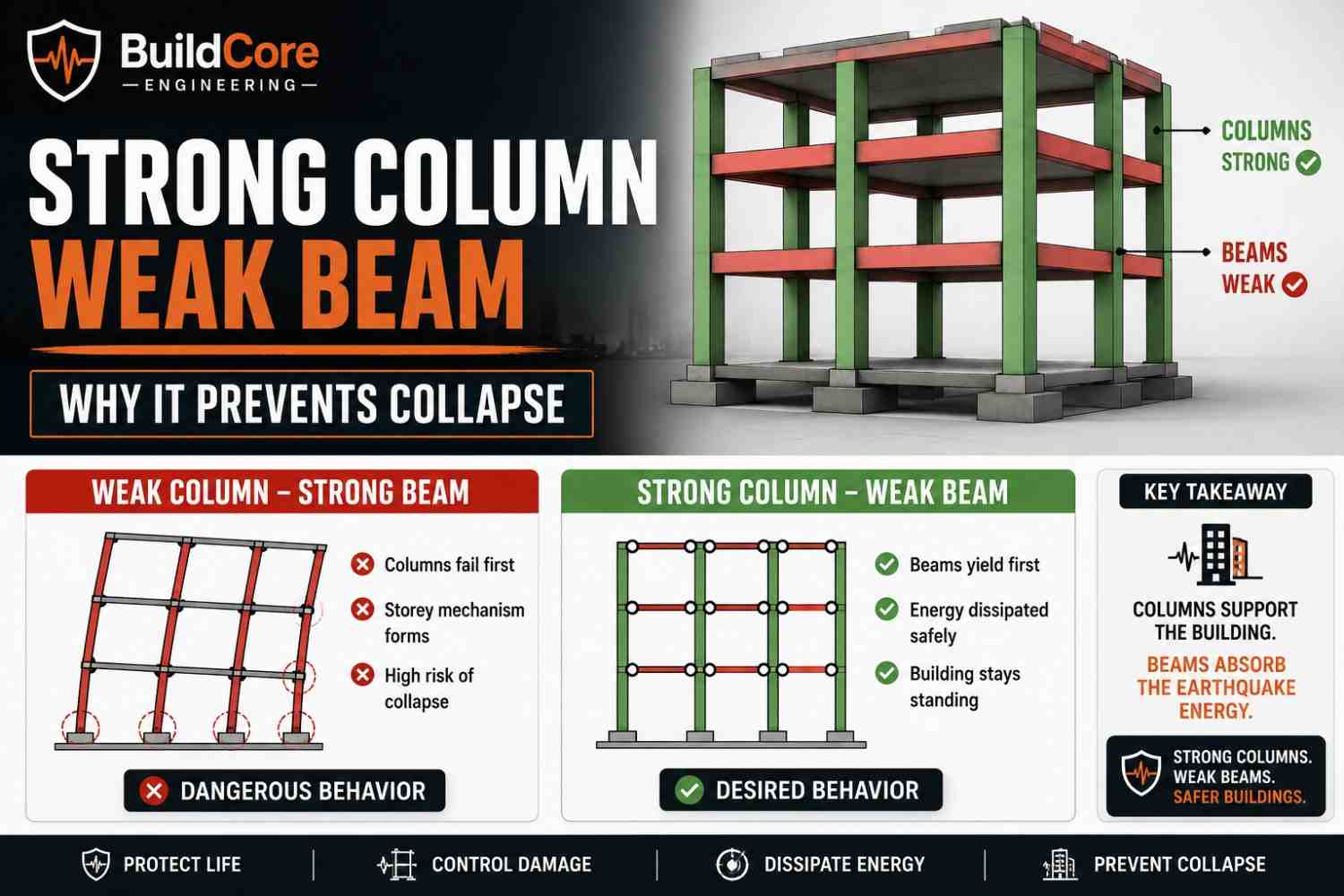
Strong Column Weak Beam Explained: The Most Important Rule in Earthquake Design
Learn what Strong Column Weak Beam means, why it is essential in seismic design, and how it prevents building collapse during earthquakes.

Common Mistakes Engineers Make in ETABS (And How to Avoid Them)
A practical guide to the most common ETABS modeling mistakes — from wrong mass source settings to incorrect diaphragm assumptions — and exactly how to fix them.

How AI is Changing Structural Engineering (And What Engineers Should Know)
Discover how AI is transforming structural engineering, what it can and cannot do, and what engineers need to understand to stay ahead.