Rigid Diaphragm vs Semi-Rigid Diaphragm: What Every Structural Engineer Should Know
Published on 2024-11-22
In structural analysis, the way a floor system distributes lateral forces plays a critical role in overall building behavior. This is where the concept of diaphragms comes in.
Two common idealizations are:
- Rigid diaphragm
- Semi-rigid diaphragm
Understanding the difference between them is essential for accurate modeling and safe design.

🧱 What is a Diaphragm?
A diaphragm is a horizontal structural element (such as a slab or deck) that transfers lateral loads to vertical resisting elements like:
- Shear walls
- Frames
- Braced systems
It acts like a load distributor during seismic or wind loading.
🟦 What is a Rigid Diaphragm?
A rigid diaphragm assumes that:
👉 The floor does not deform in its own plane
This means all points on the floor move together as a single unit.
🔹 Key Characteristics:
- No in-plane deformation
- Forces distributed based on stiffness of vertical elements
- Simple and computationally efficient
- Assumes infinite in-plane stiffness
🟧 What is a Semi-Rigid Diaphragm?
A semi-rigid diaphragm considers:
👉 The floor can deform in-plane
This allows a more realistic simulation of force distribution.
🔹 Key Characteristics:
- Includes in-plane stiffness of slab
- Captures actual deformation behavior
- More accurate load distribution
- Requires finer mesh and higher computation
⚖️ Rigid vs Semi-Rigid Diaphragm (Key Differences)
| Aspect | Rigid Diaphragm | Semi-Rigid Diaphragm |
|---|---|---|
| In-plane deformation | Ignored | Considered |
| Accuracy | Moderate | High |
| Modeling effort | Low | High |
| Force distribution | Based on stiffness only | Based on stiffness + slab deformation |
| Computational cost | Low | Higher |
🏗️ When to Use Rigid Diaphragm?
Use a rigid diaphragm when:
- Floor slab is thick and stiff
- Geometry is regular
- No significant openings in slab
- Lateral load distribution is relatively uniform
👉 Typical cases:
- Reinforced concrete slabs
- Regular buildings
⚠️ When to Use Semi-Rigid Diaphragm?
Use a semi-rigid diaphragm when:
- Slab has large openings
- Floor is flexible (steel deck, thin slab)
- Building is irregular
- Accurate torsion behavior is important
👉 Typical cases:
- Steel structures with metal deck
- Buildings with cutouts or atriums
🌀 Effect on Structural Behavior
The choice of diaphragm affects:
- Load distribution between frames/walls
- Torsional response of building
- Story drift values
- Member forces
Semi-rigid modeling often reveals:
👉 Uneven force distribution that rigid assumptions may miss
🖥️ Rigid vs Semi-Rigid in ETABS
In ETABS:
✔ Rigid Diaphragm:
- Assign diaphragm constraint
- All joints move together
- Faster analysis
✔ Semi-Rigid Diaphragm:
- Model slab as shell elements
- No diaphragm constraint
- Mesh the slab properly
🧠 Practical Engineering Insight
- Start with rigid diaphragm for preliminary design
- Switch to semi-rigid for critical or irregular structures
- Always verify torsion and drift behavior
- Do not blindly assume rigidity in flexible systems
🏁 Conclusion
The choice between rigid and semi-rigid diaphragm is not just a modeling preference—it directly impacts structural behavior and design results.
- Rigid diaphragm → simple and efficient
- Semi-rigid diaphragm → realistic and accurate
For modern and irregular structures, using a semi-rigid diaphragm can significantly improve analysis accuracy and safety.
Latest Articles
Learn structural engineering concepts and practical insights

Strong Column Weak Beam Explained: The Most Important Rule in Earthquake Design
Learn what Strong Column Weak Beam means, why it is essential in seismic design, and how it prevents building collapse during earthquakes.

Common Mistakes Engineers Make in ETABS (And How to Avoid Them)
A practical guide to the most common ETABS modeling mistakes — from wrong mass source settings to incorrect diaphragm assumptions — and exactly how to fix them.
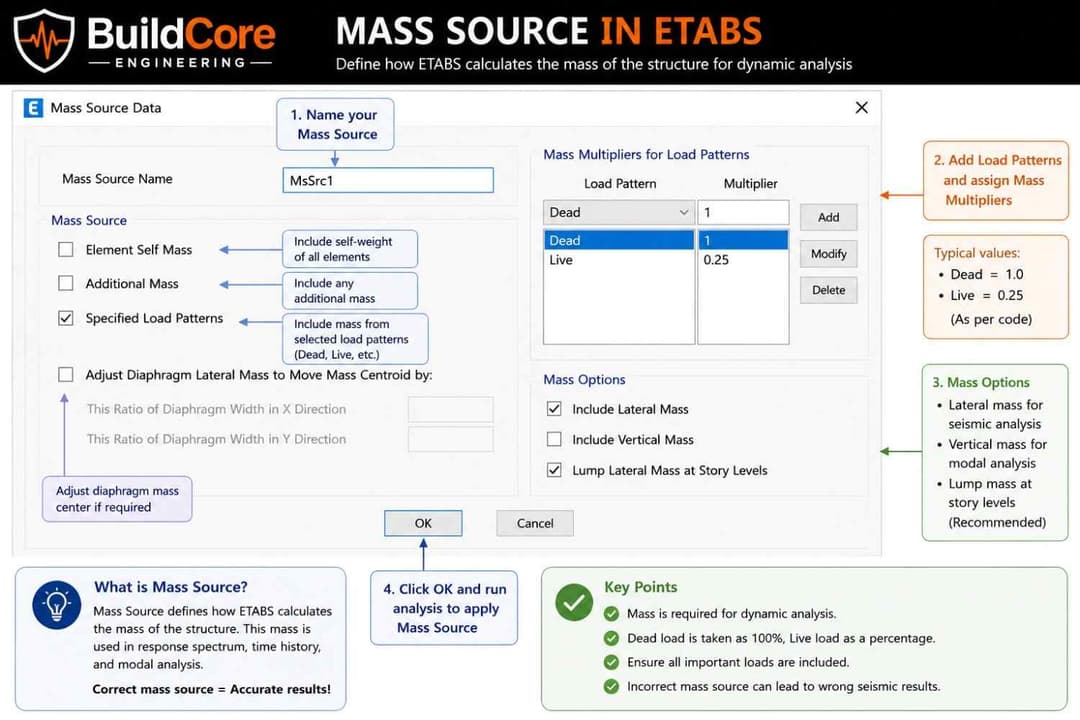
What is Mass Source in ETABS? A Simple Explanation for Structural Engineers
Learn what mass source is in ETABS, why it is important in seismic analysis, and how incorrect mass definition can lead to wrong results.