Why RSA Base Shear Must Be Scaled to Match ELF Base Shear (ASCE 7-16 Explained)
Published on 2024-11-14
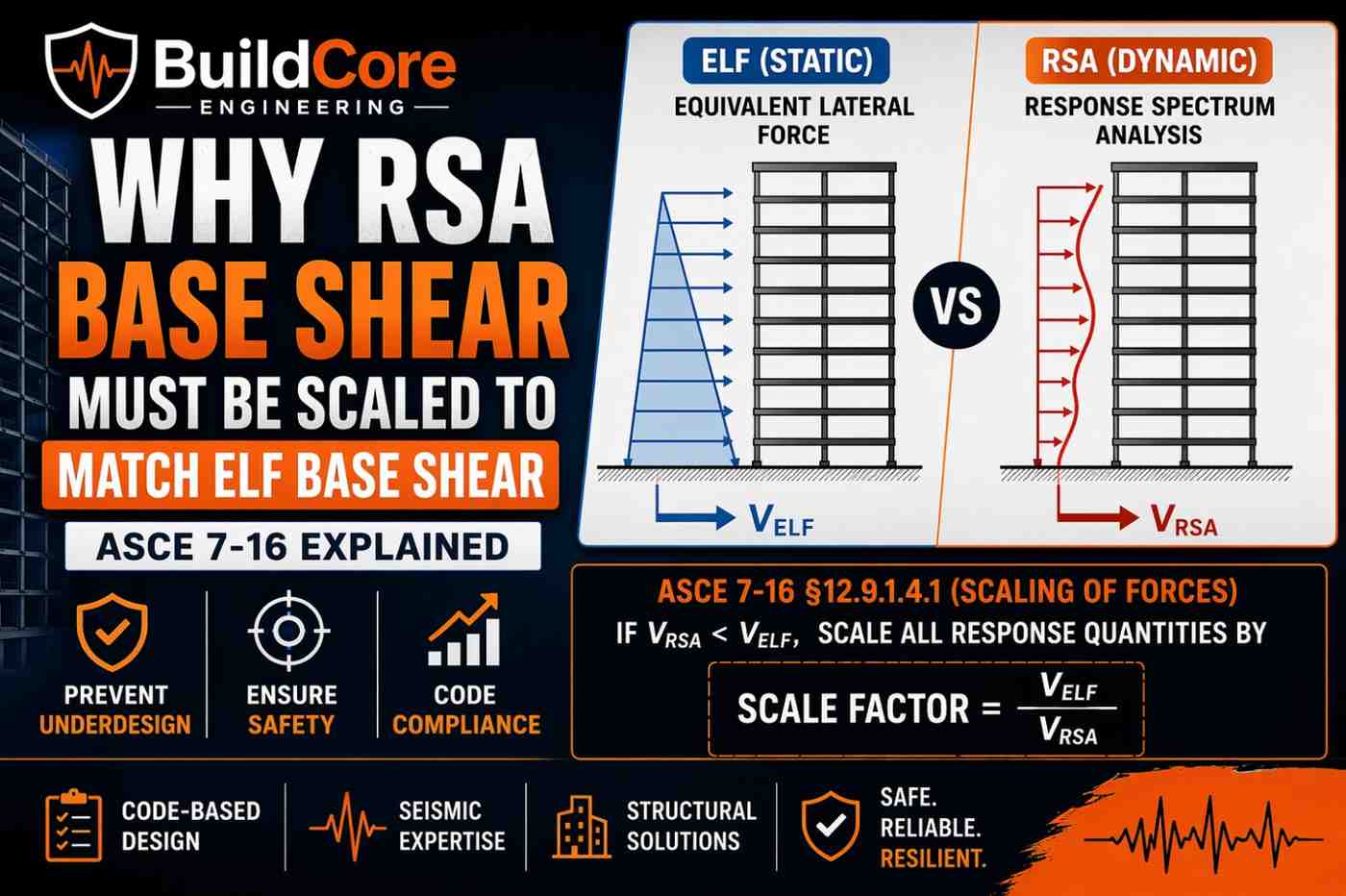
In seismic design, Response Spectrum Analysis (RSA) provides a more detailed representation of structural behavior compared to the simplified Equivalent Lateral Force (ELF) method.
However, according to ASCE 7-16, the base shear obtained from RSA cannot be less than the ELF base shear.
This raises an important question:
Why must a more advanced dynamic analysis be scaled to match a simplified static method?
Let’s break it down clearly.
📘 Code Requirement (ASCE 7-16)
According to ASCE 7-16 §12.9.1.4.1 (Scaling of Forces):
If the modal base shear () is less than the base shear () calculated using the Equivalent Lateral Force procedure, the response quantities shall be scaled by the ratio .
In simple terms:
If not:
This scaling applies to all response quantities, including:
- Story shears
- Member forces
- Overturning moments
- Torsional effects
🧱 1. ELF Provides a Minimum Safety Benchmark
The ELF method is intentionally conservative and ensures:
- Minimum strength
- Life-safety performance
- Collapse prevention
It is calibrated using historical earthquake data and engineering judgment.
👉 Therefore, ELF represents a code-defined minimum seismic demand.
🎢 2. RSA Can Underestimate Forces
RSA depends on several modeling factors:
- Modal participation
- Mass distribution
- Stiffness assumptions
- Number of modes included
- Damping
- Modal combination method (SRSS/CQC)
Because of this, RSA may produce lower base shear, especially if:
- Not enough modes are included
- Mass is missing or incorrect
- Structure is modeled too flexible
- Modal combination reduces peak response
👉 The code prevents unsafe underestimation by enforcing a lower bound.
⏱️ 3. Period Elongation Reduces RSA Forces
One of the most important reasons for low RSA base shear:
- Cracked sections → reduced stiffness
- Longer natural period ()
- Lower spectral acceleration
👉 Result: Lower base shear from RSA
Meanwhile, ELF uses:
- Approximate or capped period
- More conservative assumptions
👉 This mismatch can lead to unconservative RSA results.
🌀 4. Modal Combination Can Reduce Base Shear
In RSA:
- Different modes act in different directions
- When combined (SRSS/CQC), peaks don’t occur simultaneously
👉 This causes modal cancellation, reducing total base shear.
While physically realistic, it may:
- Underpredict design forces
- Lead to unsafe designs if unchecked
⚖️ 5. Code Philosophy: Prevent Underdesign
ASCE 7 follows a simple principle:
It is acceptable to slightly overestimate forces — but never to underestimate them.
So:
- ELF → sets minimum demand
- RSA → provides refined distribution
👉 But RSA cannot reduce overall design force below ELF
🔧 6. How Scaling Works
If:
Then all RSA results are scaled:
Important:
Only response quantities are scaled:
- ✔ Forces
- ✔ Moments
- ✔ Drifts
Not scaled:
- ❌ Mass
- ❌ Stiffness
- ❌ Model geometry
🔗 Learn More
👉 Learn how base shear is calculated step-by-step:
Seismic Base Shear Calculation
🏁 Conclusion
The requirement to scale RSA base shear to match ELF ensures:
- Safety: Prevents underestimation of seismic forces
- Consistency: Maintains minimum design strength
- Reliability: Reduces modeling sensitivity
- Code compliance: Aligns with ASCE 7-16 provisions
Even though RSA is more advanced, it can sometimes produce unconservative results due to modeling assumptions and dynamic effects.
The ELF method, backed by empirical calibration, serves as a minimum safety baseline.
👉 This approach combines:
- The accuracy of dynamic analysis
- The reliability of conservative design
Resulting in structures that are both efficient and safe.
Latest Articles
Learn structural engineering concepts and practical insights

Strong Column Weak Beam Explained: The Most Important Rule in Earthquake Design
Learn what Strong Column Weak Beam means, why it is essential in seismic design, and how it prevents building collapse during earthquakes.
Common Mistakes Engineers Make in ETABS (And How to Avoid Them)
A practical guide to the most common ETABS modeling mistakes — from wrong mass source settings to incorrect diaphragm assumptions — and exactly how to fix them.
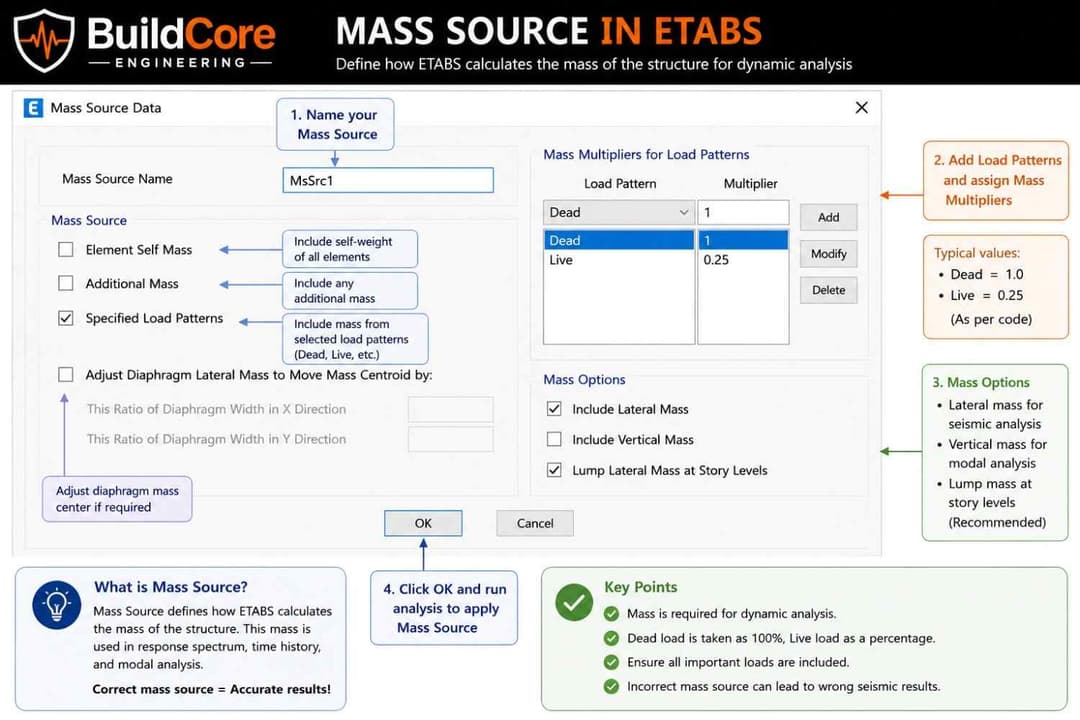
What is Mass Source in ETABS? A Simple Explanation for Structural Engineers
Learn what mass source is in ETABS, why it is important in seismic analysis, and how incorrect mass definition can lead to wrong results.